

Localized media is the practice of customizing content, advertising, and messaging to match the cultural and linguistic context of a specific community. The benefits of localized media go far beyond translation. Businesses that adapt their content to local audiences see higher conversion rates in non-English markets compared to non-localized sites. High-quality localization can drive a 20–50% revenue increase, and 10% of businesses report that localization accounts for more than half their revenue growth. For local business owners and marketers, this is not a nice-to-have. It is a direct path to stronger community relationships and measurable brand growth. 16wmediagroup helps businesses in competitive markets like Tampa build exactly that kind of local presence.
What are the real benefits of localized media?
Localized media builds trust at the community level, and trust converts. 76% of consumers prefer buying products with information in their native language. Even more telling, 40% of consumers avoid websites that are not localized, even when they understand English. That behavior reflects something deeper than language preference. It reflects a desire to feel seen and understood by the brands they support.
The industry term for this practice is “content localization,” which covers language, cultural adaptation, imagery, and local context. The phrase “localized media” captures the same idea applied across advertising, publishing, and community content. Both terms describe the same goal: making your brand feel like it belongs in the community you serve.
Local businesses that invest in localized content gain three core advantages. They earn community trust faster than brands with generic messaging. They appear more prominently in local search results. They create the kind of familiarity that turns first-time buyers into repeat customers.

How does localized media drive stronger community connections?
Localized media is a pro-social force, not just a marketing tool. Effective local media counters misinformation, reinforces community identity, and creates trusted communal spaces that global social media algorithms cannot replicate. When a business publishes content that reflects local stories, local values, and local voices, it becomes part of the community fabric rather than just another advertiser.
The social impact of local media runs deeper than most marketers expect. Research shows that communities with more local news have lower loneliness rates. Local news encourages people to identify with and engage in their community. That same dynamic applies to local business content. When your brand consistently shows up in community conversations, you build the kind of social presence that advertising alone cannot buy.
“Local media builds community identity unlike global social media algorithms that fragment reality. It reproduces local culture and counters disinformation at the neighborhood level.”
Cultural adaptation is the part most businesses skip. Localization goes well beyond swapping one language for another. It means using imagery that reflects your local audience, referencing local events and landmarks, and communicating in a tone that matches how your community actually speaks. A Tampa restaurant that publishes content about local sports teams, neighborhood events, and regional food culture will always outperform a generic brand running national copy.
- Community trust: Localized content signals that your brand understands and respects the local audience.
- Social cohesion: Local media creates shared reference points that strengthen neighborhood identity.
- Misinformation resistance: Trusted local sources reduce the spread of false information within communities.
- Reduced isolation: Consistent local content keeps community members informed and connected.
Pro Tip: Start a community-based content series that features local customers, events, or causes. This single tactic builds social proof and community goodwill simultaneously.
How does localized media impact marketing performance?
Localized media directly improves conversion rates, and the data is clear. Localized websites experience 1.5x higher conversion rates in non-English markets compared to non-localized sites. That lift comes from reducing friction. When a potential customer sees familiar payment options, recognizable date formats, and culturally relevant imagery, they trust the experience enough to complete a purchase.
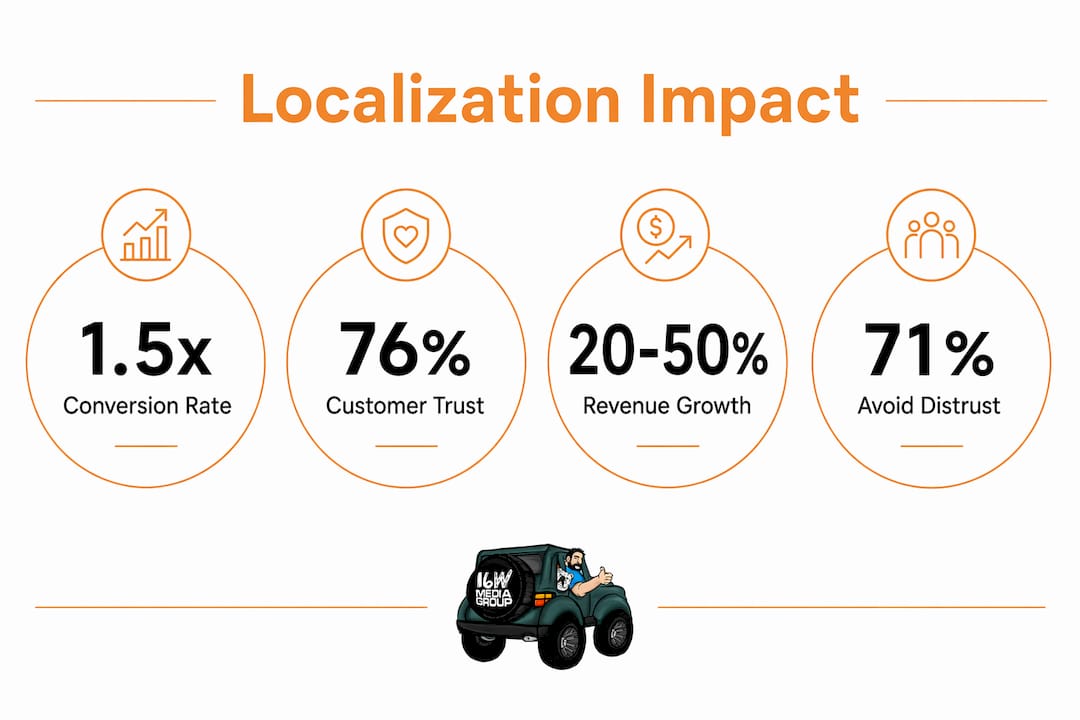
71% of users report a lack of trust with poorly localized content. That distrust damages brand relationships before a sale ever happens. For local businesses, where reputation is everything, this is a critical risk to manage.
| Marketing metric | Impact of localization |
|---|---|
| Conversion rate | Up to 1.5x higher in localized markets |
| Revenue growth | 20–50% increase with high-quality localization |
| Customer trust | 71% of users distrust poorly localized content |
| Cost efficiency | AI-assisted localization reduces costs by 30–90% |
Localized SEO is another area where local businesses gain a measurable edge. Technical SEO elements like metadata, hreflang tags, and schema markup are required for local discoverability. Without these foundations, even well-written local content will not rank in local search results. This means your investment in great community content only pays off when the technical layer supports it.
AI-powered localization platforms have changed the cost equation significantly. Businesses can reduce localization costs by 30–90% using AI-assisted platforms combined with human review cycles. That cost reduction makes localization accessible for small and mid-sized local businesses, not just enterprise brands.
Pro Tip: Pair your localized content with a localized marketing plan that maps each content piece to a specific community segment or neighborhood. Specificity drives results.
What are the best practices for localized content?
Effective localization follows a clear sequence. Starting with your highest-traffic assets delivers the fastest return. Homepage, checkout pages, and top support articles are the three areas where localization investment pays off fastest. These are the pages where customers make decisions, and friction at these points kills conversions.
- Audit your highest-traffic pages first. Identify which pages drive the most visits and conversions. Localize these before anything else.
- Go beyond language. Cultural adaptation means updating imagery, payment options, date formats, and tone to match local expectations. A translated page that still feels foreign will not convert.
- Coordinate across teams. Full-funnel localization requires alignment between marketing, product, legal, and support teams. Siloed localization creates inconsistent customer experiences.
- Use AI with human review. AI-driven platforms speed up production and reduce costs. Human review cycles catch cultural errors that AI misses. The combination produces quality at scale.
- Test before you launch. Pseudo-localization testing, which simulates translated content length and character sets during development, prevents costly UI failures before they reach your audience.
Pro Tip: Use a media planning checklist to confirm that every localized campaign covers language, cultural signals, SEO metadata, and team alignment before launch.
What mistakes should you avoid in localized media campaigns?
The most common mistake is treating localization as pure translation. Language is the entry point, not the destination. A business that translates its website but keeps generic stock photos, unfamiliar payment methods, and culturally neutral messaging has done the minimum. That minimum rarely moves the needle on trust or conversion.
- Skipping technical SEO: Localized content without proper metadata and hreflang tags will not rank in local search. The content investment is wasted without the technical foundation.
- Ignoring cultural signals: Imagery, color choices, and local references matter as much as words. A brand that looks foreign to its local audience will feel foreign.
- Treating localization as a one-time project: Communities evolve. Effective localized media requires ongoing updates to stay relevant and accurate.
- Measuring only reach: Reach tells you how many people saw your content. Conversion rate, customer retention, and engagement depth tell you whether localization is actually working.
Businesses that view localization as a cost center consistently underinvest and underperform. The correct frame is growth accelerator. Every dollar spent on localization that increases conversion rate, reduces customer acquisition cost, or improves retention generates a return that compounds over time. Tracking these metrics separately from general marketing spend makes the ROI visible and defensible.
Key Takeaways
Localized media is the single most direct investment a local business can make to build community trust, improve conversion rates, and grow brand loyalty in a specific market.
| Point | Details |
|---|---|
| Localization drives revenue | High-quality localization can increase revenue by 20–50%, with measurable conversion lifts. |
| Trust depends on cultural fit | 71% of users distrust poorly localized content, making cultural adaptation non-negotiable. |
| Start with high-traffic pages | Localizing homepage, checkout, and support pages delivers the fastest return on investment. |
| Technical SEO is required | Metadata, hreflang tags, and schema markup are necessary for local content to rank in search. |
| Community content builds loyalty | Local media that reflects community identity reduces isolation and deepens brand relationships. |
Why I think most local businesses underestimate localization
Most local business owners I talk to think of localization as something global brands do. They picture multinational companies translating websites into 30 languages. That framing causes them to miss the opportunity sitting right in front of them.
Localization for a local business means speaking the language of your specific neighborhood, not just the country. It means your content references the things your customers actually care about, the local teams, the community events, the regional issues that shape daily life. A business in Tampa that publishes content about Tampa, not generic content about “your city,” builds a connection that no national brand can replicate.
The businesses I have seen grow fastest through localized media treat it as a relationship strategy, not a content strategy. They ask: “Does this content make someone in our community feel understood?” When the answer is yes consistently, the brand loyalty that follows is genuinely difficult for competitors to displace. Start small. Pick one neighborhood, one community topic, one local story. Do that well before you scale. The compounding effect of consistent, authentic local content is more powerful than any single campaign.
— Mike
How 16wmediagroup helps you get localized media right
Local businesses that want to grow through community connection need more than good intentions. They need a media partner who understands the local market and knows how to build campaigns that resonate at the neighborhood level.
16wmediagroup specializes in exactly that kind of work. From community magazines and podcasts to regional advertising packages, the team builds localized advertising campaigns that connect brands with high-value local consumers. Whether you are planning your first local campaign or refining an existing strategy, 16wmediagroup offers the tools, channels, and expertise to make your localized media investment count. The services page outlines the full range of publishing, podcast, and traditional media options available to local businesses ready to build real community presence.
FAQ
What is localized media and why does it matter for local businesses?
Localized media is content and advertising customized to match the cultural, linguistic, and community context of a specific local audience. It matters because 76% of consumers prefer buying from brands that communicate in their native language and cultural context, which directly increases trust and conversion rates.
How does localized content improve conversion rates?
Localized websites experience up to 1.5x higher conversion rates in non-English markets compared to non-localized sites. Familiar language, cultural signals, and local payment options reduce friction and increase buyer confidence.
What is the difference between translation and localization?
Translation converts words from one language to another. Localization adapts the full experience, including imagery, payment methods, date formats, cultural references, and tone, so the content feels native to the local audience rather than simply translated.
How do I measure the success of a localized media campaign?
Track conversion rate, customer retention, engagement depth, and cost per acquisition separately for localized markets. These metrics reveal whether localization is building real business value beyond surface-level reach.
What are the best practices for localized landing pages?
Start by localizing your highest-traffic pages, including homepage and checkout, then add cultural adaptation beyond language, integrate technical SEO elements like hreflang tags, and coordinate across marketing, product, and support teams for a consistent experience.