
Running a broad ad campaign in Tampa is a quick way to burn your budget on people who will never walk through your door or pick up the phone. The good news is that local businesses willing to shift toward targeted media campaigns can unlock a dramatically better return. Hyper-local targeting has been shown to increase conversions anywhere from 18% to 45% compared to unfocused approaches. This guide walks you through exactly what targeted campaigns are, what you need to get started, how to launch step by step, and how to measure every dollar you spend.
Table of Contents
- Understanding targeted media campaigns
- What you need to start: Tools and setup checklist
- Step-by-step: Launching your targeted campaign
- Measuring results and fine-tuning performance
- Beyond the basics: What most Tampa businesses miss about targeted media
- Level up your Tampa campaigns with expert help
- Frequently asked questions
Key Takeaways
| Point | Details |
|---|---|
| Target locally, not broadly | Narrowing your campaign focus increases relevance and ROI by reaching customers near your business. |
| Prepare key assets and tools | Success depends on having solid creative, right platform setup, and concise location settings. |
| Follow a proven process | A clear step-by-step approach lets you launch, monitor, and optimize with confidence. |
| Track and tweak metrics | Compare your results to Tampa and small business benchmarks to adjust for maximum return. |
| Expert help drives results | Leverage specialized knowledge to get the most out of sophisticated targeting tools and strategies. |
Understanding targeted media campaigns
Targeted media campaigns are not just “ads with a small radius.” They are precisely engineered systems that serve your message only to the people most likely to act on it, in the areas where you actually do business. The difference from broad campaigns is fundamental. A broad campaign might reach 100,000 people across the state; a targeted campaign might reach 8,000 people in Westchase or South Tampa who searched for your service in the last 72 hours. That’s a dramatically different conversation.
What separates targeted from broad
Most local businesses start out running general awareness ads. They pick an interest category, set a statewide location, and hope for the best. Targeted campaigns flip that approach. Instead of casting the widest net, you define precise conditions: geography, search intent, device type, time of day, and past behavior.
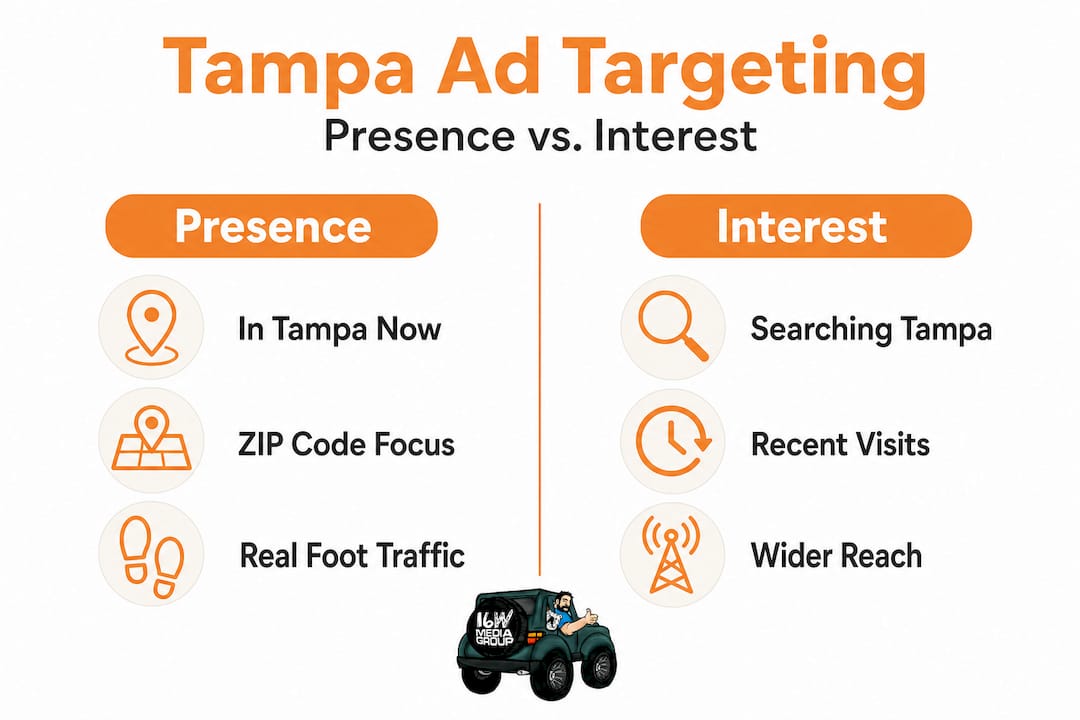
Google Ads location targeting gives you two distinct modes that most Tampa business owners overlook. Presence targeting shows your ads only to people physically located in your selected area. Interest targeting shows ads to anyone who has shown interest in your area, which could mean someone in Ohio researching Tampa restaurants before a vacation. For most local businesses, presence targeting is the smarter choice. You want paying customers who can actually visit you, not curious browsers from a thousand miles away.
Core targeting methods local businesses use
Here is a quick overview of the primary targeting levers available to you:
- Geo-radius targeting: Draw a circle (typically 5 to 15 miles) around your business location
- ZIP code targeting: Serve ads only within specific ZIP codes that match your service area
- Neighborhood targeting: Focus on named areas like Hyde Park, Seminole Heights, or Carrollwood
- “Near me” keyword targeting: Capture high-intent searches like “plumber near me” or “best coffee near me”
- Exclusion zones: Block irrelevant areas from seeing your ads entirely to stop wasted spend
The last point deserves extra attention. Excluding underperforming regions is one of the fastest ways to improve your cost per lead. If you run a service business in North Tampa and your ads keep triggering in Brandon or Clearwater, you are paying for clicks that rarely convert. Exclusions fix that immediately.
Presence vs. interest: a quick comparison
| Setting | Who sees your ad | Best for |
|---|---|---|
| Presence targeting | People physically in your area | Local foot traffic, service businesses |
| Interest targeting | Anyone interested in your area | Tourism, event promotion, relocators |
| ZIP code targeting | Users in specific ZIP codes | Hyper-local retail, neighborhood services |
| Radius targeting | Users within a set distance | Restaurants, gyms, urgent care |
For a deeper look at how localized marketing strategies work in practice, including channel selection and community engagement, there is a lot more to unpack. And if you want to go even further, hyperlocal digital advertising in Tampa is a growing practice that separates neighborhood leaders from their competition.
What you need to start: Tools and setup checklist
Before you spend a single dollar on ads, you need a few critical pieces in place. Skipping this step is the number one reason campaigns fail out of the gate.
Your pre-launch checklist
- A functioning, mobile-optimized website with a clear call-to-action on every page
- Google Ads and Meta (Facebook/Instagram) ad accounts verified and linked to your business
- Google Business Profile (GBP) claimed, verified, and fully filled out with hours, photos, and reviews
- Conversion tracking installed on your website (Google Tag Manager makes this manageable)
- Creative assets ready: at minimum three ad images, two headline options, and one short video if possible
- A defined monthly budget with 20 to 30% already earmarked for retargeting
Platform comparison: where to run your Tampa ads
| Platform | Best targeting feature | Ideal for | Minimum budget |
|---|---|---|---|
| Google Search | High-intent keyword targeting | Service businesses, urgent needs | $300-$500/month |
| Google Display | Geo-radius + remarketing | Brand awareness, retail | $200-$400/month |
| Facebook/Instagram | Lookalike + radius + interest layers | Restaurants, events, B2C products | $200-$500/month |
| YouTube (Google) | Video geo-targeting | Brand storytelling, education | $300+/month |
For Facebook and Instagram specifically, local business ad targeting works best when you use “People living in this location” rather than “People recently in this location” for stable local audiences. Layer a 5 to 10 mile radius for restaurants or a 10 to 25 mile radius for service businesses. Then stack a lookalike audience built from your existing customer list on top of that geo-layer. This combination catches both new prospects and people who behave just like your best customers.
When choosing which channels to prioritize first, understanding the best advertising channels for your specific industry type makes a measurable difference in how quickly you see returns.
Pro Tip: Set a frequency cap of no more than three ad impressions per day per user on Facebook and Instagram. Showing the same ad seven times in a day does not improve conversions; it creates ad fatigue and actively damages your brand perception.
Step-by-step: Launching your targeted campaign
With your accounts set up and creative assets ready, here is the exact sequence to follow for a focused, effective campaign launch.
1. Define your campaign objective. Choose “Leads,” “Local Store Visits,” or “Sales” as your objective. Never run local campaigns on a “Brand Awareness” objective if your goal is phone calls or foot traffic.
2. Build your audience first. Before touching budget settings, finalize your geographic parameters. Select your ZIP codes or radius, exclude non-service areas, and set demographic filters if your product skews toward a specific age or income bracket.
3. Develop location-specific creative. Generic stock images do not perform in Tampa. Use real photos of your storefront, your team, or recognizable Tampa landmarks when possible. A local face or a familiar street builds instant trust with your audience.

4. Write neighborhood-specific ad copy. “Serving South Tampa families since 2011” outperforms “Serving Tampa since 2011” in every A/B test we have run. Specificity converts.
5. Set up retargeting audiences before you launch. Do not wait until you have traffic to set up retargeting. Install your pixel or Google tag now, create a website visitor audience, and let it start populating. Retargeting best practices recommend segmenting website visitors by page visited, so someone who viewed your pricing page gets a different ad than someone who only hit your homepage. Allocate 20 to 30% of your total budget here.
6. Allocate budget with intention. Divide your monthly spend roughly 70% to prospecting (finding new customers) and 30% to retargeting (bringing back warm visitors). Adjust after 30 days based on where cost per lead is lowest.
7. Launch with a 48-hour monitoring window. Set a calendar reminder to check performance 48 hours post-launch. Look for zero-impression keywords, abnormal click-through rates, and any spend going to excluded regions that slipped through.
“Tampa businesses running tightly targeted digital campaigns regularly see return on ad spend between 5:1 and 6:1 when geographic precision, intent-matched creative, and retargeting are combined.” Based on SMB marketing benchmarks, the Google Search median click-through rate sits at 3.2%, with a median conversion rate of 3.8% and ROAS ranging from 2.5x to 6.2x depending on vertical.
Pro Tip: The single fastest creative upgrade you can make is replacing a generic “Call Us Today” CTA with something hyper-specific like “Get a free estimate in South Tampa this week.” Specificity signals relevance, and relevance drives clicks from the right people.
For a more detailed breakdown of how the full ad campaign strategy guide applies to Tampa market conditions, including how to structure your account for scalability, there is a lot of ground to cover beyond a single launch.
Measuring results and fine-tuning performance
Launching your campaign is the beginning, not the finish line. The businesses that win in Tampa’s competitive market are the ones that read their numbers clearly and adjust without emotion.
Metrics that actually matter
- Impressions: How many times your ad was shown. High impressions with low clicks signals a creative or relevance problem.
- Click-through rate (CTR): Google Search benchmark is 3.2%. If you are under 1.5%, your headlines need work.
- Cost per lead (CPL): Case studies show hyper-local targeting achieving CPL between $7.60 and $42 depending on industry.
- Conversion rate: SMB benchmark sits at 3.8% for Google Search. Below 2% usually points to a landing page issue, not an ad issue.
- Return on ad spend (ROAS): This is your revenue generated per dollar spent. Target at least 3x before scaling.
Sample Tampa campaign metrics vs. national averages
| Metric | National average | Tampa hyper-local target | Action if below target |
|---|---|---|---|
| CTR (Google Search) | 2.1% | 3.0-4.5% | Rewrite headlines |
| Conversion rate | 3.2% | 3.8-5.5% | Improve landing page |
| CPL | $35-$60 | $7.60-$42 | Tighten geo-targeting |
| ROAS | 2.0x | 3.0x-6.2x | Shift budget to best performer |
When to make changes
Do not touch your campaign in the first seven days unless something is clearly broken. After that, look for these signals:
- CTR below 1.5% for two consecutive weeks: rewrite your top ads
- One ad group consuming 60%+ of spend with low conversions: reduce its budget and test new creative
- Specific ZIP codes with zero conversions after 200 clicks: exclude them
- Mobile spend high but conversion rate low: add a mobile-specific bid adjustment or build a faster mobile landing page
Fine-tuning your media planning strategies is an ongoing discipline, not a one-time setup task.
Beyond the basics: What most Tampa businesses miss about targeted media
Here is an uncomfortable truth. Most Tampa business owners spend weeks tweaking geographic radii, swapping audiences, and adjusting bids. Then they are frustrated when results plateau. The problem is rarely the settings. It is the strategy underneath them.
Targeting alone is not enough. Research on political media buying makes a point that transfers directly to local business advertising: hyper-local prioritizes ROI over broad reach, but targeting without adequate frequency and reach management often leads to under-delivery. In plain terms, if your ads only show to 200 people twice a month, you are not building recognition or trust. You are just appearing occasionally.
The businesses we see breaking through in Tampa are doing something different. They are combining their paid campaigns with an optimized Google Business Profile that generates organic foot traffic. They are running geo-targeted social ads alongside high-intent search campaigns rather than treating them as separate efforts. And they are tracking store visits and offline conversions to understand what is actually driving people through the door, not just clicking an ad.
Another common mistake is treating campaign optimization as a one-time event. We regularly see business owners make three changes at once, see a dip in results, and then reverse everything. That is not optimization. That is guessing. Change one variable at a time, let it run for at least two weeks, and then evaluate.
The most underestimated lever in a local campaign is creative quality. Audience refinement gets diminishing returns quickly. But moving from a weak headline to a genuinely compelling, locally relevant message can double your CTR overnight. If you are spending more time in your targeting settings than on your ad copy and imagery, you have your priorities backwards.
For Tampa businesses focused on growth, building local brand awareness fast is not just about ad spend. It is about showing up consistently, relevantly, and memorably in the neighborhoods you serve.
Level up your Tampa campaigns with expert help
Running these campaigns well takes time, testing, and genuine familiarity with the Tampa market. If you are ready to move faster or want a partner who already knows what works in this city, we can help you skip the trial-and-error phase entirely.
At 16W Media Group, we build targeted media plans designed specifically for Tampa businesses that want to attract high-value customers and build real community presence. From our campaign services covering paid digital, community publishing, and podcast advertising to real-world affluent neighborhood case studies that show what precision targeting looks like in practice, we bring the full picture. Reach out today and we will walk you through a custom plan built around your goals, your neighborhood, and your budget.
Frequently asked questions
What is the difference between geo-targeting and radius targeting?
Geo-targeting selects defined areas like specific cities or ZIP codes, while radius targeting focuses on a set distance around a specific address. Radius works best for businesses where proximity is the key purchase driver, like restaurants or urgent care clinics.
How much should I budget for a local media campaign?
Retargeting best practices suggest allocating 20 to 30% of your total budget to retargeting warm audiences. Some Tampa businesses see strong results starting at a few hundred dollars per month, especially in lower-competition ZIP codes.
How soon can I expect results from a targeted campaign?
Initial data like clicks, calls, and form submissions often appears within days of launch. However, meaningful conversion lift typically takes 2 to 4 weeks, and hyper-local targeting has shown conversion improvements of 18 to 45% once the campaign has enough data to optimize.
Which platforms are best for Tampa targeting: Google or Facebook?
Both platforms are valuable but for different reasons. Google excels at capturing high-intent search behavior, while Facebook and Instagram offer stronger geo-radius layering and lookalike audience tools. Running both in tandem typically produces the strongest combined results.
What are common mistakes to avoid with local media campaigns?
Avoid using broad interest targeting instead of presence-based location settings, setting your radius too small to generate sufficient impressions, or forgetting to exclude non-service regions. Each of these mistakes leads to wasted spend and skewed performance data.
Recommended
- Media planning strategies that grow Tampa businesses
- Hyperlocal Digital Advertising in Tampa: Accelerate Your Brand’s Local Authority – 16W Media Group
- Tampa Marketing Agency: Accelerating Your Brand on The Branding Highway (2026) – 16W Media Group
- Accelerating Growth: The Definitive Guide to Media Buying Services in Tampa (2026) – 16W Media Group