
Your marketing budget isn’t an expense; it’s fuel, but without a functional dashboard, you’re just burning cash on a crowded Florida highway. You likely feel the friction of rising advertising costs and the constant struggle to link an online click to an offline sale. With 40% of marketers reporting that proving ROI is their biggest hurdle, the pressure is on to ensure every dollar drives your business forward. Successfully measuring local marketing ROI in Florida requires more than just basic math; it demands a navigation strategy calibrated for our unique, high-speed market.
We’re here to help you clear the congestion. You’ll master the precise metrics and attribution models needed to track and accelerate your returns with total precision. This article provides a clear framework for tracking every dollar spent, reclaiming wasted manufacturer co-op funds, and building the confidence to scale your winning campaigns. It’s time to stop guessing and start driving toward the growth your business deserves. Follow this roadmap to see how all roads lead to your business.
Key Takeaways
- Navigate the data noise created by Florida’s unique seasonal demographics to find the true signal in your local marketing performance.
- Master the “Big 4” metrics—CAC, ROAS, Lead-to-Close, and CLV—to transform your advertising from a cost center into a high-speed growth engine.
- Deploy advanced attribution models for measuring local marketing ROI in Florida that accurately credit community-focused publishing and long-term brand building.
- Reclaim wasted manufacturer co-op funds and audit your historical data using a streamlined, five-step strategic roadmap.
- Accelerate your results by removing the friction points that stall momentum in the state’s most competitive local markets.
The Florida Friction: Why Standard ROI Formulas Fail Local Brands
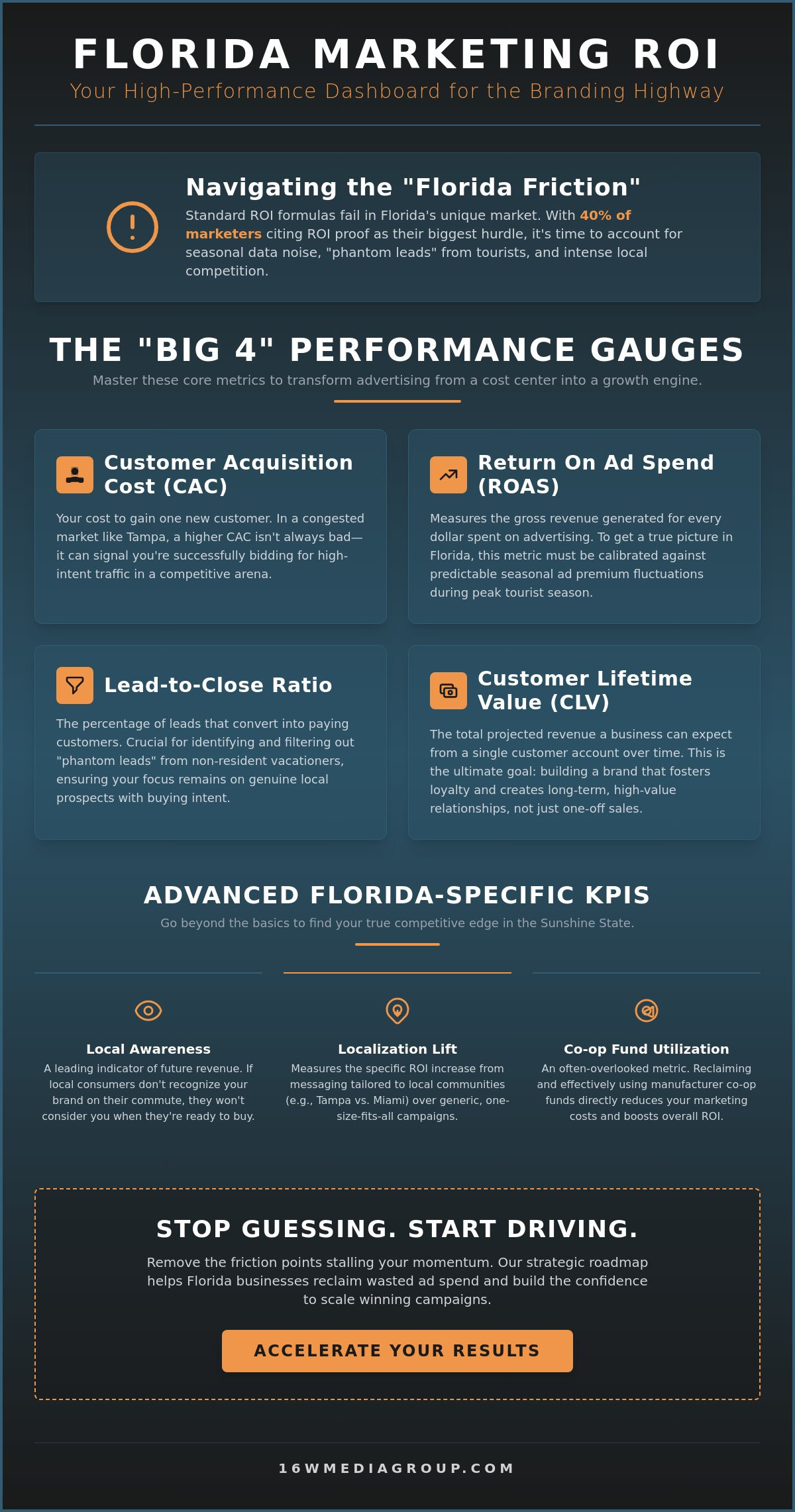
Standard ROI math often hits a wall the moment it crosses the Florida state line. If you’re using a basic revenue-minus-cost formula, you’re missing the friction points that stall growth in our unique landscape. Measuring local marketing ROI in Florida requires a more sophisticated lens because our market isn’t a steady line; it’s a fluctuating highway with massive seasonal shifts. While the standard Return on Marketing Investment (ROMI) provides a baseline, it doesn’t account for the “noise” created by 140 million annual visitors or the seasonal surge of snowbirds. These demographics create data interference that makes standard models look successful on paper while your actual bank account remains stagnant.
We utilize “The Branding Highway” approach to move past surface-level vanity metrics. Clicks and impressions are just rest stops; they don’t represent the final destination. In Florida, you face “localization friction” when national messaging fails to resonate with local communities. This friction drags down your returns because Florida consumers value local trust over generic corporate promises. If your strategy doesn’t speak to the specific needs of a Tampa homeowner or a Miami professional, you’re essentially driving with the emergency brake on. You need a roadmap that accounts for high-season ad premiums and intense localized competition to see the true picture of your performance.
Accounting for Florida Seasonality
Success in Florida requires shifting your perspective based on the calendar. During Q1, peak season brings a surge of high-value consumers, but it also drives up the cost of digital and print inventory. You can’t compare a January lead cost to a July lead cost and expect a clear answer. Seasonal ROI Calibration for Florida retail markets is the strategic adjustment of conversion benchmarks to align with the state’s predictable fluctuations in tourism traffic and part-time resident spending. You must also identify “phantom leads” generated by non-resident traffic. These are individuals who engage with your ads while on vacation but have zero intention of becoming long-term customers, effectively inflating your lead count while depressing your actual ROI.
The Cost of Market Congestion in Cities like Tampa
In high-velocity hubs like Tampa, the road is always crowded. Many businesses panic when they see a rising Cost Per Acquisition (CPA), but in a congested market, a higher CPA might actually indicate a healthier brand presence. It shows you’re successfully bidding for high-intent traffic in a competitive environment. Building brand authority acts as a lubricant that lowers these costs over time. When you partner with a specialized Tampa marketing agency, you gain the local insights needed to navigate these traffic jams. Measuring local marketing ROI in Florida means understanding that initial acquisition costs are just one part of the journey; the goal is to build a brand that consumers recognize and trust before they even see your next ad.
Key Performance Indicators (KPIs) for the Sunshine State
To stay ahead on the Branding Highway, you need a high-performance dashboard. Measuring local marketing ROI in Florida isn’t just about looking at the rearview mirror; it’s about tracking the metrics that drive you forward. You can’t rely on generic stats when your business operates in a high-velocity market like Tampa or Orlando. You need the “Big 4” metrics to gauge your engine’s health: Customer Acquisition Cost (CAC), Return on Ad Spend (ROAS), Lead-to-Close Ratio, and Customer Lifetime Value (CLV). These are your primary gauges, but they don’t tell the whole story in a state with such diverse regional demographics.
Local Awareness is often dismissed as a vanity metric, but it’s actually a leading indicator of future revenue. If potential customers don’t recognize your brand while they’re navigating their daily commute or browsing local news, they won’t think of you when they’re ready to buy. We also track “Localization Lift,” which measures the specific increase in ROI when your messaging is tailored to local neighborhoods rather than using a generic national template. When you speak the language of your community, you remove the friction that slows down conversions and increases your overall profitability.
Measuring Co-op Advertising Efficiency
One of the most overlooked KPIs is Co-op Fund Utilization. Many Florida businesses leave money on the table because they find manufacturer requirements too complex. When you effectively leverage co-op advertising, you’re essentially getting a turbo boost for your budget. We track compliance and reimbursement speed as key health markers. If your co-op dollars aren’t being processed and reinvested quickly, your growth engine is idling. Tracking this ensures you’re utilizing every available dollar to lower your effective CAC and maximize your reach.
Digital vs. Print: A Unified ROI View
Don’t fall into the trap of viewing digital and print as separate roads. There’s a powerful “halo effect” where Community-Focused Print and Digital Publishing work together to drive results. A high-quality print ad often triggers a digital search, but without the right Marketing attribution models, the print ad gets zero credit. By using localized QR codes and unique landing pages, you can bridge the gap and see exactly how each medium contributes to your bottom line. This unified view is essential for measuring local marketing ROI in Florida accurately. If you want to see how these roads connect for your brand, explore our strategic navigation services and start accelerating your growth today.
Attribution Models: Fast-Tracking the Path from Impression to Sale
If your marketing strategy is a highway, attribution is the GPS that tells you which turns actually lead to the bank. Measuring local marketing ROI in Florida becomes a guessing game if you rely on outdated models that only look at the final click. Many businesses fall into the trap of “Last-Touch” attribution, which gives 100% of the credit to the very last link a customer clicked before buying. This is like giving all the credit for a successful road trip to the exit ramp while ignoring the hundreds of miles of highway that got you there. For Florida brands, this model often undervalues community-focused publishing and long-term brand building that creates the initial desire to shop.
A “First-Touch” model identifies the spark, but “Multi-Touch” attribution is the gold standard for high-velocity markets. It allows you to assign fractional value to every interaction, from a resident seeing your name in a local magazine to hearing a strategic insight on The Branding Highway podcast. By using geofencing data, we can even bridge the gap between digital spend and physical reality. This technology allows us to attribute a physical store visit in Sarasota or Naples to a specific digital ad seen days prior, providing a clear picture of how your online presence drives offline revenue. This level of precision removes the friction of “dark social” and untraceable word-of-mouth.
The Multi-Touch Reality in Florida Retail
Consider a typical consumer journey in Tampa. A high-value customer might first see your brand in a community-focused print piece, listen to a localized podcast episode during their commute, and finally click a retargeting ad on social media before making a purchase. If you only track that final click, you’ll mistakenly cut the budget for the awareness channels that actually fueled the engine. Attribution Decay is the mathematical reduction in the perceived value of a marketing touchpoint as the time between that interaction and the final conversion increases in a fast-paced local market. To avoid this, you must assign fractional value to early awareness stages to justify the spend that keeps your pipeline full.
Tracking Local Influencer and Community Impact
Measuring the ROI of community narratives requires looking beyond simple link clicks. We use social listening tools to track brand affinity shifts in specific Florida regions, seeing how localized storytelling changes the way people talk about your business. When you invest in strategic brand localization, you aren’t just buying ads; you’re building a community asset. Measuring local marketing ROI in Florida means quantifying this trust. By tracking mentions, sentiment, and direct engagement within localized digital circles, you can see the tangible lift that community-focused strategies provide to your overall conversion rates. This data ensures every road in your marketing plan leads directly to your business.
The Local ROI Roadmap: A 5-Step Process for Florida Businesses
Measuring local marketing ROI in Florida isn’t a one-time event; it’s a continuous loop of performance tuning. To move from stagnant growth to high-speed results, you need a disciplined process that identifies exactly where your budget is driving value and where it’s stalling. This roadmap removes the guesswork, allowing you to reallocate fuel to the lanes that actually lead to conversions. By following these steps, you’ll transform your marketing spend from a black hole of expenses into a transparent engine for growth.
- Step 1: Define Your Baseline. You can’t accelerate if you don’t know your current speed. Audit your historical data and current spend across all Florida markets to establish a clear starting line.
- Step 2: Install Your Dashboard. Implement granular tracking across every channel. This includes setting up UTM parameters for digital ads and unique tracking numbers for print campaigns.
- Step 3: Audit Individual Lanes. Calculate the specific ROI for each channel. Isolate the performance of your social media, community publishing, and co-op advertising to see which is pulling its weight.
- Step 4: Measure the Localization Turbo. Compare the performance of generic brand creative against localized, community-centric messaging. This is where you identify the “Localization Lift.”
- Step 5: Hit the Fast Lane. Optimization is about momentum. Reallocate your budget away from underperforming channels and double down on the strategies that drive the highest return.
Step 2: Setting Up Your Tracking Infrastructure
Your tracking infrastructure is the instrument cluster of your business. For Florida brands, Google Analytics 4 is essential, but it shouldn’t stand alone. You need deep CRM integration to connect a lead’s first click to their final purchase. Call tracking software is also vital, especially for service-based businesses where the final sale happens over the phone. Ensure your co-op advertising management is fully integrated into this reporting dashboard. If you can’t see your manufacturer reimbursements alongside your ad spend, you aren’t measuring local marketing ROI in Florida accurately. This unified view ensures no dollar is left on the table and every campaign is held accountable.
Step 4: Testing Localization Strategies
National brand creative often lacks the “trust factor” required to convert in competitive hubs like Tampa or Orlando. We recommend A/B testing community-centric content against standard corporate assets to measure the difference in engagement. When you utilize Strategic Brand Localization, you’re speaking directly to the local consumer’s identity. This approach often results in a significant lift in conversion rates because it removes the friction of anonymity. If you’re ready to stop burning cash on generic ads and start driving real results, connect with our strategic navigators today to audit your current roadmap.
Accelerating Your Results with 16W Media Group
Measuring local marketing ROI in Florida shouldn’t feel like driving in circles. At 16W Media Group, we act as your Strategic Navigator, cutting through the market congestion that stalls most brands. We understand that the Florida market is uniquely competitive, especially as the 2026 economic stabilization shifts consumer sentiment toward more cautious spending. Our mission is to remove the friction points that stall momentum, such as wasted budgets and uncoordinated messaging, ensuring your engine runs at peak efficiency. We provide the high-speed solutions needed to turn your marketing spend into a clear path for growth.
Our unique approach to co-op advertising management is a central pillar of our success. We ensure no money is left on the table by handling the complex compliance and reimbursement cycles that often overwhelm local retailers. By reclaiming these funds, we effectively lower your acquisition costs and increase your total reach without requiring additional capital from your pocket. This isn’t just about tracking spend; it’s about maximizing every available resource to fuel your expansion. Mike and Norman have built this agency to be a vehicle for your rapid growth, combining the tactical skills of a national firm with deep local roots.
Where All Roads Lead to Your Business
We connect your brand to high-value consumers through community-focused media that builds genuine trust. Whether it’s through our specialized print publications or strategic sponsorships on The Branding Highway podcast, we help you achieve national brand relevance through hyper-local execution. This localized strategy removes the anonymity that often kills conversions in cities like Tampa. Our results-oriented media buying eliminates waste, ensuring that measuring local marketing ROI in Florida becomes a story of consistent profit rather than a math problem.
Every strategy we build is designed to move the needle as quickly as possible. We don’t just provide data; we provide a clear roadmap where all roads lead to your business. If you’re ready to stop idling and start driving toward your goals, it’s time to join us on the highway. Give us a call at 813-72-BRAND to see how we can fast-track your success.
Accelerate your Florida marketing ROI with 16W Media Group and start your journey today.
Take the Wheel: Your Fast-Track to Marketing Clarity
Your business doesn’t have to stall in the face of market congestion. By moving past surface-level vanity metrics and embracing a multi-touch attribution model, you gain the visibility needed to scale with confidence. We’ve shown that measuring local marketing ROI in Florida requires a specialized roadmap that accounts for seasonality, localized trust, and the strategic utilization of co-op funds. Don’t let your manufacturer advertising dollars sit idle when they could be fueling your next expansion.
As specialists in Tampa market penetration and the hosts of The Branding Highway podcast, we know how to navigate the specific friction points of the Sunshine State. We’ve managed millions in co-op advertising funds to ensure our partners maximize every dollar. It’s time to stop guessing and start driving with a dashboard built for results. Your growth isn’t just a possibility; it’s the inevitable destination when you follow a proven strategy.
Drive your growth and accelerate your ROI—Contact 16W Media Group today. We’re ready to help you clear the road and reach the high-value consumers waiting for your brand. Let’s get moving.
Frequently Asked Questions
What is a good marketing ROI for a local business in Florida?
A 5:1 revenue-to-ad-spend ratio is a solid benchmark for most local Florida businesses. In high-growth areas like Tampa, you should look beyond immediate sales to customer lifetime value. If you spend $1,000 and generate $5,000 in revenue, your engine is running well. We focus on ensuring your return stays ahead of the state’s competitive ad premiums by optimizing every stage of your funnel.
How do I measure the ROI of print advertising in a digital world?
You track print ROI by using localized tracking tools like unique landing pages and mnemonic phone numbers. These tools act as sensors on the road, capturing the transition from physical reading to digital action. By monitoring how many people scan a QR code or call 813-72-BRAND, you can quantify the direct impact of your community publishing efforts. This bridges the gap between offline awareness and online conversion.
Can I track ROI for co-op advertising programs?
Tracking co-op ROI is possible when you integrate manufacturer requirements into your primary reporting dashboard. You should measure the total sales lift against the net cost after reimbursement. This calculation shows the true efficiency of your shared budget and ensures you aren’t leaving money on the table. It turns a complex compliance process into a transparent growth engine for your local brand.
How does Florida seasonality affect my ROI data?
Florida seasonality creates significant data interference that you must filter to understand your true performance. Measuring local marketing ROI in Florida requires adjusting your expectations for the Q1 surge versus the quieter summer months. If you don’t calibrate for these predictable fluctuations, you might mistakenly cut budgets during periods that are actually driving long-term brand equity and preparing you for the next peak season.
What are the most important KPIs for local brand localization?
The most vital KPIs include Localization Lift and regional lead-to-close ratios. You need to see how much more effective your messaging is when it’s tailored to a specific Florida neighborhood versus a generic national ad. Track how local awareness shifts within specific zip codes to predict future revenue growth. These metrics tell you if your brand is truly connecting with the community or just adding to the noise.
How long does it take to see a positive ROI on community-focused marketing?
Most businesses see a positive return within a 90 to 180-day window. While digital “fast lanes” can show results in weeks, community-focused storytelling takes longer to build the trust needed for high-value conversions. This foundation eventually lowers your total acquisition costs and builds a moat around your business. It’s an investment in momentum that pays dividends as your brand becomes a local staple.
Is social media marketing ROI higher than traditional media in Florida?
ROI isn’t about one medium being better; it’s about how they work together on the Branding Highway. Social media often shows a higher immediate ROAS because it captures the final click in the journey. However, traditional media like community print often provides the initial spark. Without that offline awareness, your social ads would likely face much higher friction and significantly lower conversion rates.
Why is my CAC higher in Florida than in other states?
Your Customer Acquisition Cost is likely higher because you’re competing in one of the most crowded advertising landscapes in the country. Florida’s high-value consumer base attracts national brands, driving up the cost of local attention. Measuring local marketing ROI in Florida helps you identify if that higher CAC is justified by a higher lifetime value or if you need to optimize your strategy to bypass the most expensive traffic jams.