

Strategic local storytelling for social change is the deliberate practice of crafting and sharing community-rooted narratives to inspire action, build collective power, and challenge the dominant stories that hold communities back. Done well, it is not just communication. It is a tool for shifting who gets heard, whose history gets honored, and what futures feel possible.
Here is what separates strategic storytelling from casual community sharing:
- Clear objectives: Every story connects to a specific, measurable community outcome, not a vague aspiration.
- Authentic local grounding: Stories name real places, real people, and real stakes that community members recognize immediately.
- Diverse voices: No single hero carries the narrative. Multiple perspectives, especially from those most affected, shape the story together.
- Asset-based framing: Stories lead with what communities have, not what they lack.
- A call to action: Every story ends with a concrete next step that converts attention into participation.
- Ethical accountability: Storytellers respect participant agency, protect dignity, and avoid exploitative or extractive narrative practices.
This walkthrough moves through each layer of that practice, from building your strategy and choosing your methods, to structuring stories for emotional impact, integrating storytelling into your organizing campaigns, and measuring what actually changes.
What does a local storytelling strategies walkthrough actually cover?
The phrase “local storytelling strategies walkthrough” describes a step-by-step approach to narrative work that is grounded in community context and oriented toward social change. The recognized industry term for this practice is narrative strategy, defined by organizations like Storytellers for Change as the process of imagining, crafting, and sharing stories to reinforce and amplify equity-centered narratives. Both terms are useful: “narrative strategy” signals the professional framework, while a practical walkthrough is what makes that framework usable for organizers working in real communities with real constraints.
The community development sector has a well-documented problem with dominant narratives. Research commissioned by the Robert Wood Johnson Foundation identified eleven prevailing narratives in the field that reinforce scarcity and deficit thinking, disproportionately affecting communities of color. Counter-narratives, built through intentional local storytelling, are the direct response. They move communities from a scarcity mindset to an abundance mindset, and from colorblind framing to explicitly anti-racist approaches that center resident-led decision making.
This walkthrough is built for community organizers, nonprofit leaders, and activists who want that shift to happen on purpose, not by accident.
How do you build a storytelling strategy for social change?
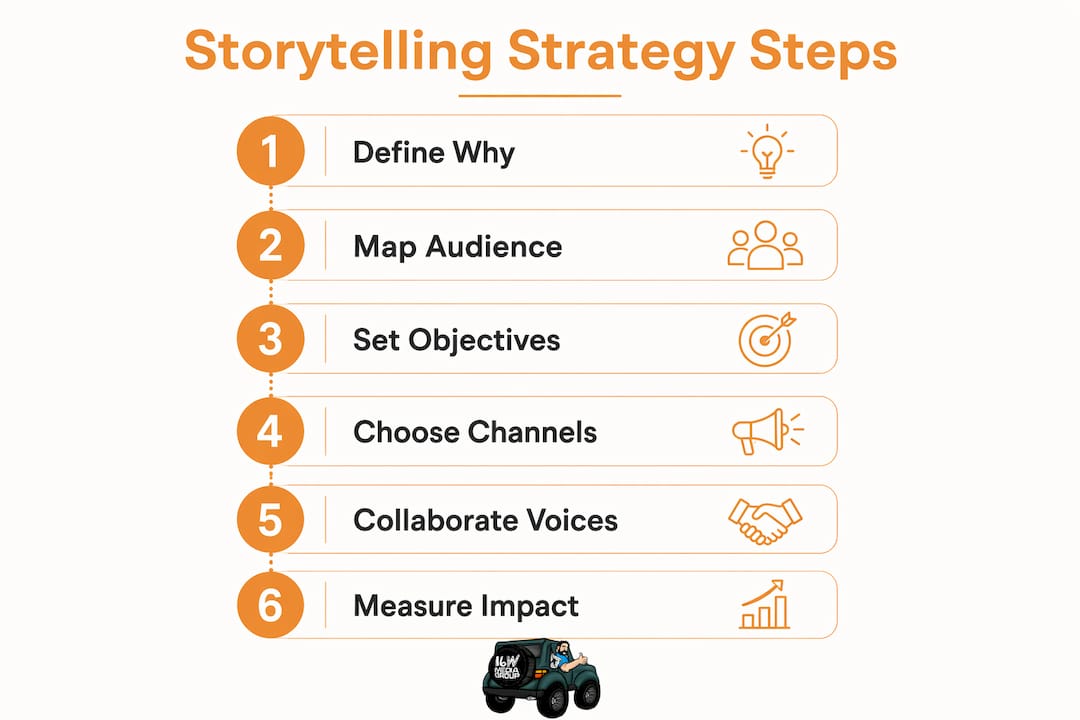
Strategy comes before story. Without it, even the most compelling narrative drifts, fails to reach the right people, or produces no measurable change. A solid narrative strategy has five interconnected components.
Setting objectives tied to real outcomes
Start with your “why,” your “what,” and your “how.” Your why is the values and commitments driving your narrative work. Your what is the specific impact objective: a policy change, increased voter turnout in a particular precinct, broader participation in a community planning process, or a shift in how local media covers your neighborhood. Your how is the principles that will guide every story you tell. Vague objectives produce vague stories. Specific goals produce stories that move people toward a defined action.

Audience and community mapping
Traditional communication frameworks ask you to map your audience. Equity-centered narrative strategy goes further: it asks you to map the communities most impacted by your work, paying close attention to power dynamics and diversity. Audiences and communities overlap, but they are not the same. Your audience might be city council members. Your community is the residents whose lives depend on what those council members decide. Both groups need to be mapped, understood, and addressed differently.
Anti-racist, equity-centered principles
The biggest trap in community storytelling is relying on deficit-based narratives that focus on what communities lack rather than their cultural wealth. Equity-centered storytelling embeds local history, honors community knowledge, and actively counters narratives that have been used to justify disinvestment or over-policing. This is not a values add-on. It is the structural foundation of effective narrative strategy.
Selecting channels and tactics
Narratives travel through murals, videos, poetry, theater, journalism, newsletters, podcasts, community fairs, and social media. The right channel depends on your objectives, your community’s media habits, and your organizational capacity. A neighborhood with strong oral tradition might respond better to a live story circle than a written op-ed. A campaign targeting local elected officials might need both a compelling video and a well-placed magazine feature. Community publishing is one of the most direct ways to put storytelling control in the hands of the people most affected.
Collaborative, polyvocal storytelling
Authentic community narratives require multiple voices and perspectives, not a single spokesperson or a single hero arc. Polyvocal storytelling recognizes diverse community knowledge and histories, and it distributes narrative power rather than concentrating it. That distribution is itself a form of community empowerment.

Pro Tip: Assign three distinct facilitation roles for every storytelling session: a host who manages the room and relationships, a data guide who tracks themes and key insights, and a storytelling lead who shapes the narrative arc. Role clarity prevents sessions from becoming abstract or unfocused, and it keeps the output usable.
Which techniques make local storytelling genuinely compelling?
Methods and techniques are where strategy becomes craft. The following approaches are proven in community organizing contexts and adaptable across formats.
Core storytelling methods
- Community story-mapping: Teams of three to four people collect stories from community members, known in many traditions as “griots,” to uncover assets, understand challenges, and plan collective action. The process builds trust and co-created purpose through shared reflection.
- Griot interviews: Structured conversations with long-term community members who hold institutional memory. Interviewers use guiding questions to start the story, then probing questions to go deeper, letting the narrative emerge as a dialogue rather than an interrogation.
- Polyvocal narrative projects: Deliberately gathering stories from people across age, race, gender, and neighborhood to produce a composite community portrait that no single voice could create alone.
- Review-to-story workflows: Preserving a community member’s or participant’s exact words, then adding a short factual setup: what the person needed, what happened, and what changed. That format reads like a mini case study and gives audiences the context to trust the claim.
Narrative techniques that convert attention into action
Show, don’t tell is the single most powerful technique for community storytelling. Rather than stating that a neighborhood is resilient, show a resident who organized her block during a flood, named the street, described the water level, and called three neighbors who showed up with supplies. The specificity does the work that adjectives cannot.
Local vernacular and detail anchor stories in shared reality. Naming the neighborhood, the street, the local event, or the seasonal pattern that shapes daily life signals to community members that the storyteller operates in the same conditions they do. That recognition reduces uncertainty and increases trust.
Foreshadowing creates forward momentum. Hint early at the tension or transformation to come, and audiences stay engaged through the middle of the story where most narratives lose them.
Asset-based framing replaces deficit language at every turn. Instead of “a community struggling with disinvestment,” try “a community that built its own mutual aid network when city services failed.” The facts can be the same. The frame determines whether audiences see a problem to be solved by outsiders or a community with the capacity to lead its own change.
Formats and physical storytelling tools
Written stories, audio narratives, and video each reach different audiences and serve different purposes. Audio storytelling placed at 200–400 meter intervals along urban walking routes aligns with natural pedestrian pacing and listener attention spans, making it a practical tool for neighborhood history tours or civic engagement campaigns. Physical formats like small-run zines and postcards create scarcity and tangible value that increase community engagement and give stories a life beyond the screen.
For teams producing audio content across multiple contributors, collaborative podcast editing practices help maintain consistent voice and quality without flattening the diversity of perspectives that make polyvocal storytelling work.
Sustaining a storytelling workflow requires templates, not just inspiration. A repeatable structure: local hook, one-sentence problem, one-sentence decision, one-sentence outcome, one action step, keeps content consistent across channels and makes it possible for a team to publish regularly without reinventing the format every time.
How does the three-act structure work for community stories?
The three-act structure is the most widely used framework in storytelling for social change, and for good reason. It maps directly onto how humans process narrative: context, conflict, and resolution. Applied to community organizing, it becomes a practical tool for building stories that move audiences from awareness to action.
The three acts defined
| Act | Function | Key elements |
|---|---|---|
| Act 1: Beginning | Establish context and stakes | Introduce the community, the character, and what is at risk |
| Act 2: Middle | Present conflict and response | Show the challenge, the decision made, and the community’s response |
| Act 3: End | Deliver transformation and lesson | Reveal the outcome, the change achieved, and the call to action |
The standard structural foundation for storytelling in social change contexts follows this arc, with stories planned around specific, actionable goals and all sensory elements outlined to maintain audience engagement throughout.
Act 1: Setting the context and stakes
The beginning sets the tone and hints at what is coming by raising the right questions in the audience’s mind. Introduce your character or community in a specific, recognizable setting. Name the neighborhood. Describe the physical space. Establish what is normal before the conflict arrives. Then clarify the stakes: what does this community stand to win or lose? Defining clear stakes is critical to creating the emotional resonance that moves communities to action. Without stakes, a story is just a sequence of events.
Act 2: Conflict and community response
The middle must move progressively forward. Each event should build on the last, increasing tension and involvement as the story advances. This is where most community stories go wrong: the middle becomes a list of activities rather than a chain of logic proving the story’s core assertion. Every scene in the middle should answer one question: why does this matter, and what did the community do about it? Show the decision, not just the problem. Show the people who showed up, not just the obstacle they faced.
Act 3: Transformation and the call to action
The end delivers the lesson and the invitation. What changed? What did the community learn? And what can the audience do right now, with low friction, to join that story? Stories built around outcomes with clear calls to low-friction actions convert audiences from passive observers to active participants. “Attend the next meeting,” “sign the petition at this link,” “share this story with one neighbor” are all specific enough to act on immediately.
Scripting for consistency
For audiovisual storytelling, script every element: the words spoken, the visual sequences, the audio cues, and the behavioral actions that should appear on camera. Ad-libbing produces inconsistent takes and wastes production time. A thorough script is a blueprint, not a constraint. It protects the story’s emotional arc and makes it possible to reproduce the same quality across multiple storytellers and formats.
How do you integrate storytelling into community organizing campaigns?
Storytelling is most powerful when it is built into the structure of your organizing work, not added on as a communications afterthought. Here is how to make that integration practical and sustainable.
Identifying authentic community storytellers
The best storytellers in any community are often not the most visible leaders. Look for people with deep roots: long-term residents, elders, youth who have grown up watching the neighborhood change, small business owners who have navigated multiple economic cycles. The community story-mapping process is one of the most reliable methods for finding them, because it sends teams into the community rather than waiting for people to come to a meeting.
Building storytelling into outreach and events
- Embed a short story share at the opening of every community meeting, two to three minutes from a different community member each time.
- Design workshops around story collection, not just information delivery. Participants leave with a story they have told and heard, not just a handout.
- Use story circles before campaign launches to surface the community’s own language for the issue, then use that language in all public-facing materials.
- Attach storytelling to physical community spaces: a mural with a QR code linking to audio stories, a bulletin board with rotating written narratives, a zine distributed at local businesses.
Ethical storytelling practices
Ethical storytelling respects participant agency at every stage. Before collecting a story, explain clearly how it will be used, who will see it, and what control the storyteller retains over their own narrative. Avoid extractive practices where organizers gather powerful personal stories and then use them without ongoing consent or credit. The people whose stories you tell should benefit from the telling, not just the campaign.
Avoid trauma-forward narratives that reduce community members to their hardest moments. Lead with strength, agency, and the specific actions people took. That framing is both more ethical and more effective at inspiring others to act.
Tools and platforms for amplifying local stories
- Podcasts and audio series: Accessible, low-cost, and well-suited to polyvocal storytelling. A bounded series of six to eight episodes creates a complete narrative arc and gives listeners a reason to stay engaged.
- Community magazines and newsletters: Print still reaches audiences that digital channels miss, and a physical publication carries credibility that a social media post rarely achieves. 16wmediagroup’s community publishing services are built specifically for this kind of local narrative work.
- Social media with local specificity: Posts tied to local timing, local events, and local places outperform generic content. End every post with one direct action step that is easy to measure.
- Traditional media partnerships: Local newspapers, radio stations, and television news still shape public opinion in ways that social media alone cannot. Build relationships with local journalists who cover community issues and pitch them story angles that center community voices.
Measuring storytelling impact
Tie every story to a specific call to action, then track the response. For digital content, track clicks, shares, form submissions, and event registrations. For in-person storytelling, track attendance changes, new volunteer sign-ups, and petition signatures collected at events where stories were shared. For policy campaigns, track whether decision-makers cite community narratives in their public statements. A media planning checklist helps align storytelling outputs with measurable campaign outcomes from the start.
Pro Tip: Maintain a consistent storytelling cadence: two strong pieces of community narrative per week outperform a single burst of content followed by silence. Assign one person to collect one photo, one quote, and one outcome note each week, stored in a shared folder with a simple naming system. That habit keeps the pipeline full without burning out your team.
What do successful local storytelling campaigns actually look like?
Real examples make the framework concrete. The following cases illustrate how the methods, structure, and strategy described above play out in practice across different community contexts.
Case 1: Community story-mapping for school advocacy
A coalition of parents and educators in a mid-sized American city used the community story-mapping process to build a case for increased school funding. Teams of three visited churches, barbershops, and community centers to interview long-term residents about how the schools had changed over two decades. The stories collected revealed a consistent pattern: the community had built strong informal support networks precisely because formal resources had been cut. That asset-based framing replaced the deficit narrative the school board had been using to justify further cuts. The coalition presented the compiled stories at a public budget hearing, and three council members cited the narratives directly in their floor statements. The result was a restored funding line that had been eliminated two years earlier.
- Strategy applied: Equity-centered framing, polyvocal collection, clear policy objective
- Structure used: Three-act arc with community as protagonist
- Channel: Live public testimony supported by a printed story compilation
- Measurable outcome: Policy change at the municipal level
Case 2: Hyperlocal audio storytelling for neighborhood identity
A neighborhood association in a rapidly gentrifying urban district produced a bounded audio series of eight episodes, each anchored to a specific block or landmark. Stories were collected from residents who had lived in the neighborhood for twenty or more years, then edited for a walking tour format with audio placed at intervals that matched natural pedestrian pacing. The series was distributed via QR codes on laminated cards attached to utility poles and distributed at local businesses. New residents who completed the tour reported a stronger sense of connection to the neighborhood’s history, and the association saw a measurable increase in attendance at its monthly meetings in the months following the launch.
- Strategy applied: Asset-based framing, physical and digital channel integration, bounded series format
- Structure used: Individual episode arcs nested within an overarching neighborhood narrative
- Channel: Audio walking tour with physical distribution touchpoints
- Measurable outcome: Increased civic participation
Case 3: Review-to-story workflow for a mutual aid network
A mutual aid network used a structured review-to-story workflow to document its impact during a local housing crisis. Volunteers collected short accounts from people who had received assistance, preserving the person’s exact words and adding a brief factual setup: what the person needed, what the network did, and what changed afterward. These mini case studies were published weekly in a community newsletter and shared on social media with a single action step: “Donate $10 to keep this going.” The network tracked donations directly tied to each story post and found that posts using the case study format consistently outperformed posts with general appeals. The workflow became a permanent part of the network’s communications practice.
- Strategy applied: Asset-based framing, ethical consent process, repeatable template
- Structure used: Problem, response, outcome, call to action
- Channel: Newsletter and social media with direct donation link
- Measurable outcome: Increased donation conversion rate per post
Case 4: Zine-based storytelling for youth civic engagement
A youth-led organization in a low-income neighborhood produced a quarterly zine featuring stories written by young people about their own community. Each issue focused on a single theme: housing, food access, school safety, or environmental conditions. The zines were printed in small runs, creating scarcity and tangible value that made each issue feel worth keeping. Distribution happened through schools, libraries, and community centers. Local elected officials received a copy of each issue with a one-page summary of the policy asks embedded in the stories. Over two years, the organization documented three instances where elected officials referenced the zines in public statements, and two policy proposals that directly addressed issues the zines had surfaced.
- Strategy applied: Youth voice, polyvocal authorship, physical format for scarcity and credibility
- Structure used: Thematic collection with individual three-act story arcs
- Channel: Print zine with targeted distribution to decision-makers
- Measurable outcome: Policy influence and documented civic engagement
| Case | Community context | Primary channel | Measurable outcome |
|---|---|---|---|
| School funding advocacy | Parent and educator coalition | Live testimony and print | Restored funding line |
| Neighborhood audio tour | Gentrifying urban district | Audio walking tour with QR codes | Increased meeting attendance |
| Mutual aid network | Housing crisis response | Newsletter and social media | Higher donation conversion |
| Youth civic zine | Low-income neighborhood | Print zine with policy distribution | Three documented policy references |
The thread connecting all four cases is the same: a clear objective, community voices at the center, an asset-based frame, and a specific call to action tied to a measurable outcome. None of these campaigns relied on a single charismatic spokesperson. All of them treated storytelling as a system, not a one-time event.
How 16wmediagroup helps you amplify community narratives
Knowing the strategy is one thing. Having the media infrastructure to carry it is another. 16wmediagroup works with community organizations, nonprofits, and local campaigns to build the channels that give local stories the reach they deserve. From community-focused publishing and podcast production to regional advertising and localized media plans, 16wmediagroup connects your narrative strategy to the audiences who need to hear it.
If your organization is ready to move from storytelling intention to storytelling impact, the local advertising best practices guide is a practical next step for aligning your narrative work with a media plan that drives real community engagement. Let 16wmediagroup help you put your community’s story where it belongs: front and center.
Key Takeaways
Strategic local storytelling works when it combines clear objectives, community-centered voices, asset-based framing, and a specific call to action tied to a measurable outcome.
| Point | Details |
|---|---|
| Lead with assets, not deficits | Dominant narratives reinforce scarcity; counter them by centering community cultural wealth and resident-led action. |
| Use the three-act structure | Begin with context and stakes, build through conflict and response, and end with transformation and a clear call to action. |
| Assign facilitation roles | A host, data guide, and storytelling lead keep workshops focused and produce usable, actionable story outputs. |
| Anchor stories in local specifics | Naming the neighborhood, street, or local event builds shared reality and converts passive audiences into active participants. |
| Measure what changes | Track calls, sign-ups, donations, and policy references tied to specific stories to know which narratives drive real outcomes. |