

Most businesses spend money on advertising and hope something sticks. That approach costs more than it delivers. The role of media strategy in business growth is not just about where you place ads. It’s about connecting every media dollar to a measurable business outcome. When you treat media as a system rather than a collection of one-off campaigns, your visibility increases, your customer acquisition costs drop, and your brand earns the kind of recognition that compounds over time. This guide breaks down exactly how that works and what you can do about it starting now.
Table of Contents
- Key Takeaways
- The role of media strategy in business growth, defined
- From impressions to impact: outcome-driven media planning
- AI, social media, and content marketing in your media mix
- How to build a media strategy that actually drives growth
- My take on media strategy for SMB growth
- How 16wmediagroup helps Tampa SMBs grow through media strategy
- FAQ
Key Takeaways
| Point | Details |
|---|---|
| Strategy beats spending | A documented media strategy outperforms random ad buys by connecting channel choices to real business outcomes. |
| Vanity metrics mislead | Impressions and clicks rarely reflect revenue impact; tie media efforts to pipeline, CAC, and customer lifetime value instead. |
| Content outperforms outbound | Content marketing produces three times more leads than traditional outbound at significantly lower cost. |
| AI speeds up, humans decide | AI tools accelerate research and ideation, but brand-specific human judgment separates generic plans from great ones. |
| Consistency builds credibility | Long-term media relationships and consistent messaging generate compounding returns that short-burst campaigns cannot match. |
The role of media strategy in business growth, defined
Media strategy is the documented plan that determines which channels you use, how you use them, when you use them, and what success looks like at each stage. It’s not a content calendar. It’s not an ad budget. It’s the connective tissue between your business goals and every message you put in front of the market.
A fully formed media strategy includes five core components:
- Audience targeting: Who you are trying to reach, what they care about, and where they spend their attention
- Channel mix: Which combination of digital, traditional, and community media reaches your audience at the right moment in their buying journey
- Content and messaging: What you say, at what frequency, and in what format across each channel
- Timing and cadence: When campaigns run, how long they sustain, and how seasonality or local events factor in
- Measurement framework: Which KPIs tie back to actual business metrics rather than surface-level engagement data
The distinction between traditional and digital media matters less than most people think. What matters is whether each channel serves a specific purpose within your growth model. A local business in Tampa might find that a community magazine drives more qualified foot traffic than a Google Display campaign. Another business might see the opposite. Media strategy is what tells you which is true for your brand before you’ve wasted three months of budget finding out.
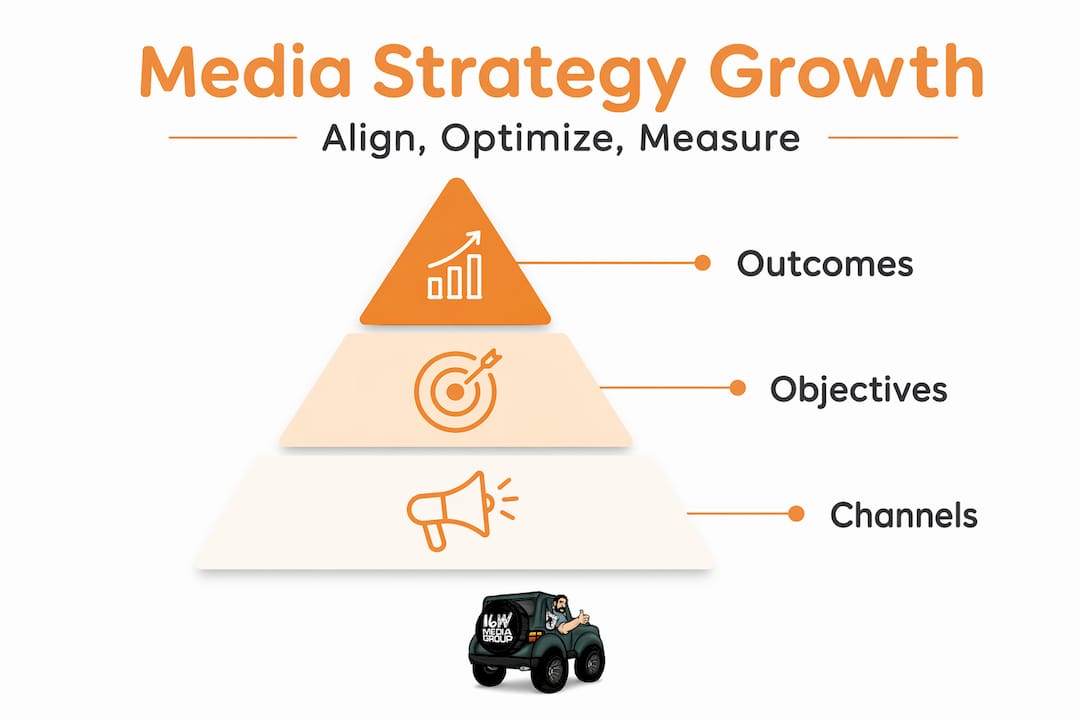
Media strategy also needs to align with your broader business objectives. If your goal is to grow revenue by 20% this year, your media plan should specify which channels contribute to awareness, which drive consideration, and which close or retain customers. Without that alignment, you’re running disconnected campaigns rather than a growth system.
From impressions to impact: outcome-driven media planning
Here’s a number that should change how you think about marketing budgets. 77% of CEOs expect marketing to demonstrate a measurable impact on business outcomes. Not brand sentiment. Not reach. Revenue.
Yet most SMB media planning still gets reported in impressions, clicks, and follower counts. Those metrics aren’t worthless, but they’re not what pays the bills. The shift to outcome-driven media planning means you evaluate every channel by what it contributes to your sales pipeline, your customer acquisition cost, and the lifetime value of the customers it brings in.
| Media planning approach | What it measures | Business relevance |
|---|---|---|
| Traditional/vanity metrics | Impressions, reach, followers, clicks | Low. No direct link to revenue. |
| Outcome-driven planning | Qualified leads, CAC, pipeline value, CLV | High. Directly tied to growth metrics. |
The good news is that outcome-based media planning makes budget conversations easier, not harder. When you can show that a specific channel generates a qualified lead at a cost that the business can sustain, you’ve given leadership a reason to invest more, not cut back.

Getting there requires the right infrastructure. You need CRM data connected to your campaign tracking, conversion goals set up beyond just form fills, and a reporting cadence that surfaces what’s working before the budget is already spent. Effective media planning also requires normalized frameworks for evaluating media channels, rather than disconnected data points that make comparison impossible.
Pro Tip: Set up UTM parameters for every media channel you run, even offline ones with unique landing page URLs. This single step connects the dots between media spend and website behavior inside your existing analytics.
AI, social media, and content marketing in your media mix
The fastest-growing area of media strategy right now is the integration of AI tools for analysis, ideation, and personalization. Nearly 80% of marketers use AI for brainstorming new media ideas. That’s a meaningful shift in how strategies get built.
AI accelerates three things that used to take days: competitive media analysis, audience segmentation modeling, and content ideation at scale. Instead of spending a week researching where your competitors are showing up, an AI tool can surface that landscape in hours. That means your team spends more time making decisions and less time gathering data.
But AI has a real limitation that most articles won’t tell you plainly. AI outputs are generic by default. The businesses that benefit most from AI-assisted media planning are the ones that feed their tools proprietary brand data, customer insights, and competitive context. Without that input, you get a media plan that looks like everyone else’s.
“Marketing leaders must operationalize and regulate AI use thoughtfully to balance efficiency gains with preserving human expertise.” — Basis Technologies
Social media is no longer just a distribution channel. For many SMBs, it’s the primary brand-building engine. Brands that prioritize social media as a core strategic pillar see an average revenue increase of 14.1% compared to their peers. That gap is significant for a small business. Even more telling: 48% of consumers say brands they follow on social media actually understand their interests and preferences. That’s a level of perceived relevance that paid advertising rarely achieves on its own.
Content marketing rounds out the modern media mix in a way that traditional outbound methods simply cannot match. Content generates three times more leads than traditional outbound marketing at 62% lower cost. The catch is that this only holds when you have a documented strategy behind it. Yet only 47% of B2B marketers have a documented content strategy, which means your SMB can gain real competitive ground just by formalizing what you’re already doing. You can explore 16wmediagroup’s content marketing resources for practical frameworks that apply directly to local business growth.
How to build a media strategy that actually drives growth
Building a media strategy that drives measurable results doesn’t require a massive budget. It requires a clear process. Here’s how to approach it as an SMB owner or marketing manager.
-
Set business-aligned media objectives. Start with a revenue or growth number and work backward. If you need 50 new customers this quarter, and your historical close rate from qualified leads is 20%, you need 250 qualified leads. That number should drive your channel budget and content plan, not the other way around.
-
Map your customer journey before selecting channels. Know whether your buyers need education before they purchase, how long their decision cycle is, and what objections they have. A local advertising campaign built around this journey converts at a higher rate than one built around channel availability.
-
Budget with incremental ROI in mind. Don’t split your budget evenly across channels to start. Put the majority into two or three channels you can measure clearly, then expand based on which ones show the strongest cost-per-acquisition. The best strategies forecast incremental impact and optimize dynamically using real-time data.
-
Build media relationships, not just media placements. Earned media and PR are often overlooked by SMBs, but credibility, connection, and consistency are the currency of lasting brand reputation. A single podcast feature, community magazine placement, or co-branded event can generate more trust than a month of paid ads.
-
Integrate your CRM with your campaign tracking. You cannot optimize what you cannot see. Connect your advertising data to your sales pipeline so you know which media touchpoints actually contribute to closed deals, not just clicks.
Pro Tip: Review your media performance on a 30-day cycle during the first quarter of any new strategy. Most businesses wait too long to make adjustments, spending significant money on channels that signaled poor performance early. Real-time optimization is a competitive advantage most SMBs leave on the table.
My take on media strategy for SMB growth
I’ve worked alongside enough small and medium business owners to know that the biggest mistake isn’t spending money on the wrong channels. It’s spending money without a system that tells you whether any channel is working.
The businesses I see grow consistently share one trait. They treat media as infrastructure, not as a series of campaigns. They invest in measuring outcomes before they scale spending. They resist the pull of vanity metrics even when the numbers look impressive at face value.
What frustrates me is how often AI gets positioned as the answer to this problem. AI is a powerful accelerator, and I use it. But I’ve seen plans produced almost entirely by AI tools that had zero grounding in the actual brand, the actual market, or the actual customer. Those plans fail. The ones that work combine AI-generated speed with deep business context that only a human who knows the company can provide.
The other thing I keep coming back to is the long game. Treating media as long-term relationship-building rather than a series of transactions changes how you show up in the market. It changes what reporters think of you, what your community associates with your brand, and how referrals flow your way over time. You don’t get that from a 30-day sprint.
Start with a clear objective. Build the measurement infrastructure first. Then invest in channels. In that order.
— Mike
How 16wmediagroup helps Tampa SMBs grow through media strategy
If you’ve recognized your business in any of this, you’re not alone. Most SMBs in competitive markets like Tampa are sitting on untapped growth because their media efforts aren’t connected to a clear strategy.
16wmediagroup specializes in exactly this: building media plans that tie every channel to measurable business outcomes. From local advertising and community publishing to digital media and podcasts, the team works with you to identify the right mix for your market, your budget, and your growth goals.
Whether you’re starting from scratch or looking to get more from what you’re already spending, 16wmediagroup gives you the structure and the expertise to make your media investment count. Explore the media planning strategies that have helped Tampa businesses grow, or take a look at the full services overview to see what a tailored approach looks like in practice.
FAQ
What is the role of media strategy in business growth?
Media strategy aligns your channel choices, content, and budget with specific business outcomes like revenue growth and customer acquisition. Without it, media spend produces activity but not results.
Why do impressions and clicks fall short as metrics?
Impressions and clicks measure attention, not conversion. Outcome-driven planning tracks qualified pipeline, customer acquisition cost, and lifetime value instead, which are the numbers that actually reflect business health.
How does content marketing compare to traditional advertising for SMBs?
Content marketing generates three times more leads than traditional outbound at 62% lower cost, but only when backed by a documented strategy. Most SMBs that create content without a strategy see limited returns.
How should SMBs use AI in their media strategy?
Use AI to speed up competitive research and content ideation, but always layer in brand-specific data and human judgment. Generic AI outputs won’t differentiate your brand in a local market where relationships and specificity matter most.
How often should a small business review its media strategy?
Review performance monthly in the first quarter of any new strategy, then quarterly once you have established baselines. Real-time data dashboards make this practical even for small teams without dedicated analysts.