

Most business professionals assume a media company is simply a content creator. That assumption costs them real money. A modern media company sits at the intersection of content creation, audience development, and advertising infrastructure. It sells two things simultaneously: content to audiences and those audiences to advertisers. YouTube generated approximately $62 billion in revenue in 2025, surpassing Disney’s media business and reshaping every assumption about what media power looks like. If you are making brand partnership or advertising decisions, you need a cleaner picture of how these organizations actually work.
Table of Contents
- Key takeaways
- What a media company actually is
- Media company types and ownership structures
- Strategic approaches for local brand engagement
- Technology and data’s role in media partnerships
- Future trends shaping media company strategies
- My honest take after years of watching brand-media partnerships unfold
- How 16wmediagroup helps local brands get media right
- FAQ
Key takeaways
| Point | Details |
|---|---|
| Audiences are inventory | Media companies sell audience access to advertisers, not just content to viewers. |
| Ownership vs. buying matters | Confusing media owners with media buyers leads to costly contract and rights errors. |
| Local targeting beats generic reach | Matching your brand to a reliable audience segment outperforms broad distribution every time. |
| Distribution plans drive results | A multi-format plan combining earned, paid, and owned media aligned to KPIs delivers measurable outcomes. |
| Technology is reshaping media deals | Programmatic advertising and AI tools have changed how media inventory is priced and sold. |
What a media company actually is
The definition sounds simple until you look closely. A media company creates, packages, and distributes content across one or more channels, then monetizes that content in multiple ways simultaneously. Revenue sources include advertising, subscriptions, licensing fees, and content sales, with audiences functioning as both paying customers and advertising inventory at the same time.
That dual role is where most executives get confused. When you watch a streaming show, you are a subscriber paying for access. At the same moment, your viewing data is being packaged and sold to advertisers to inform programmatic targeting. You are the product and the customer. Understanding that dynamic changes how you read any media partnership proposal.
Revenue streams break down into four main categories:
- Advertising revenue: Display, video, sponsorship, and programmatic placements sold against audience access.
- Subscription fees: Direct consumer payments for premium content or ad-free experiences.
- Licensing and syndication: Selling content rights to third parties, networks, or international markets.
- Royalties and IP monetization: Ongoing income from owned intellectual property across formats and platforms.
The YouTube example is instructive beyond the headline number. A platform that did not exist 20 years ago now out-earns one of the most iconic entertainment businesses on the planet. That shift happened because YouTube combined content creation at scale with a self-serve advertising platform that gave brands of every size direct access to segmented audiences without a traditional sales team in the middle.
Pro Tip: When reviewing a media partnership proposal, ask for the breakdown of ad-supported versus subscription revenue. A media company with a dominant advertising revenue model treats its audience as a product first, which shapes everything from editorial decisions to content formats.
Media company types and ownership structures
Not every media company plays the same role in the ecosystem, and treating them interchangeably is one of the most common strategic mistakes decision-makers make.
The media owner versus media buyer distinction
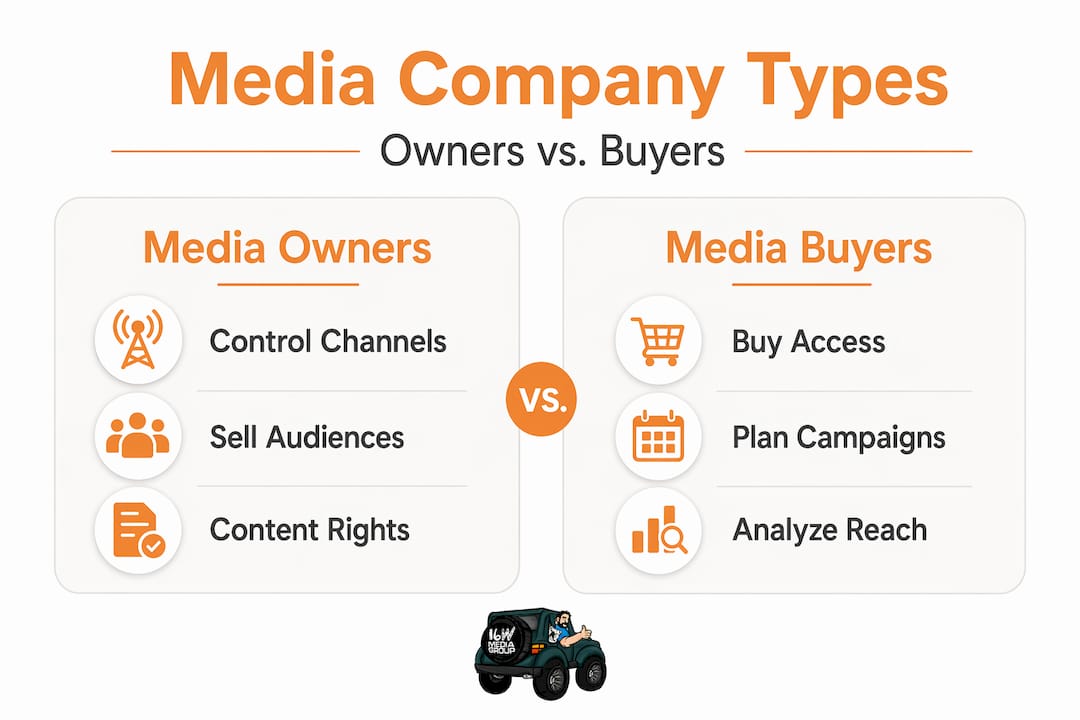
Understanding the difference between media owners and media buyers is foundational before signing any contract. A media owner controls the channel, the ad inventory, and the content rights. A media buyer purchases access to that inventory on a brand’s behalf. When you work with a digital media agency or media consultancy, you are typically working with a buyer. When you place an ad directly with a broadcaster or publisher, you are working with an owner. Confusing the two creates real problems around data ownership, content rights, and campaign performance accountability.
A comparison of modern media company types
| Type | Controls | Revenue model | Local relevance |
|---|---|---|---|
| Traditional broadcaster | TV/radio channels | Advertising, licensing | Strong for mass local reach |
| Publisher/magazine | Print and digital content | Ads, subscriptions | High for niche community targeting |
| Digital platform | Algorithm and distribution | Programmatic advertising, subscriptions | Strong but harder to localize precisely |
| Out-of-home operator | Physical ad placements | Location-based ad sales | Very strong for neighborhood-level targeting |
| Media conglomerate | Multiple channels and formats | Diversified across all above | Varies by individual brand within group |
Media owners now include global digital platforms that control programmatic advertising infrastructure. Google, Meta, and Amazon are not just platforms. They are the largest media owners in the world by ad revenue, controlling both the channel and the technology stack that prices inventory. For local brands, this creates a complicated opportunity: massive reach at low cost per impression, but with limited control over placement context and audience trust levels.

Traditional broadcasters and community publishers occupy a different position. They may have smaller audiences, but those audiences often have deeper trust relationships with the content they consume. A community magazine that covers your neighborhood carries a different brand signal than a programmatic display ad served through an exchange.
Strategic approaches for local brand engagement
Knowing the media company types is step one. Knowing how to structure an engagement with them is where most local campaigns either succeed or fail quietly.
A common mistake is treating content creation as the end goal. Content without a distribution plan is an expense, not an investment. Multi-format distribution plans aligned to specific KPIs consistently outperform approaches that focus on content quality alone. Your KPIs should drive format selection, not the other way around.
Here is a practical framework for structuring local media engagements:
- Define the audience segment first. Matching your brand offer to a reliably delivered audience segment is more important than total reach numbers. Ask every prospective media partner for verified audience data, not just circulation or traffic claims.
- Build a three-channel distribution plan. Combine earned media (editorial features, podcast appearances), paid media (sponsored placements, display, social), and owned media (your content on your platforms) into one coordinated plan with shared measurement.
- Negotiate for data rights upfront. Specify in writing what audience data you receive from the campaign, who owns that data, and how it can be used in future campaigns. This is where most local businesses leave value on the table.
- Set a measurement cadence before launch. Monthly reporting minimums with agreed metrics prevent post-campaign disputes about whether the partnership delivered.
- Plan for content reuse. Any content produced for a media partner should be licensed for use across your own channels. This extends the value of every production dollar.
Pro Tip: If a media partner cannot give you verified third-party audience data for their channel, treat their reach numbers as estimates, not guarantees. Reliable audience measurement is a sign of a professional media operation.
A well-executed community-based advertising strategy goes beyond placing ads in a local publication. It means becoming part of the content itself through editorial partnerships, podcast sponsorships, and co-branded events that generate ongoing coverage rather than a single impression.
Technology and data’s role in media partnerships
The media company you partner with today operates with a significantly different technology stack than one from five years ago. Decisions that used to be made by sales teams and editors are now partially automated, and that changes the negotiation dynamic for brands.
Programmatic advertising has created a tiered media sales strategy that most local advertisers do not fully understand. Publishers sell their premium inventory directly at higher rates, then run programmatic exchanges to fill remaining inventory at lower prices. The same audience, reached through different buying methods, comes at vastly different costs and with different contextual placements.
Key technology factors affecting brand collaboration today:
- AI-driven content production: Media companies are using AI tools to scale content output, which affects editorial quality standards and sponsored content integration practices.
- Audience-first metrics: Platform deal structures increasingly require clear IP and data rights, along with minimum performance guarantees tied to audience behavior, not just impressions.
- First-party data priority: As third-party cookies continue phasing out, media companies with strong first-party data relationships have a genuine competitive advantage for advertisers who need precision targeting.
- Programmatic precision for local campaigns: Geofencing, demographic layering, and behavioral targeting tools now allow local brands to run campaigns with the precision that previously required a national budget.
| Technology | Advertiser benefit | Watch out for |
|---|---|---|
| Programmatic buying | Lower CPMs, broader reach | Loss of placement control |
| AI content tools | Faster production timelines | Reduced editorial originality |
| First-party data targeting | Higher relevance to audience | Limited scale in local markets |
| Geofencing and location data | Neighborhood-level precision | Data accuracy varies by provider |
Social media management has also matured into a distinct function within multimedia companies. Platforms require dedicated content creation workflows, community engagement protocols, and reporting structures that differ significantly from traditional broadcasting services. When evaluating a media production services partner, verify whether social management is integrated or treated as an afterthought.
Future trends shaping media company strategies
The forces reshaping the media industry through 2026 and beyond are not subtle. Decision-makers who ignore them will find their media investments delivering diminishing returns.
Rising production costs, shifting consumer demand, IP management challenges, workforce shortages, and cybersecurity threats are pressuring media companies to restructure their business models. For brands, that pressure creates both risk and opportunity.
Key trends worth tracking:
- Creator economy integration: Independent creators now command audiences that rival traditional media channels. Smart brands are building direct relationships with creators alongside traditional media partnerships rather than treating them as separate strategies.
- Content convergence: The line between a broadcaster, publisher, and platform continues to collapse. A podcast network is also a publishing house, an advertising media solutions provider, and a community platform simultaneously.
- Ethical and sustainability expectations: Audiences increasingly scrutinize the values of the media they consume. Brand association with media companies carrying reputational risks now carries measurable business consequences.
- Measurement standardization: The industry is moving toward unified audience measurement standards that will make cross-channel campaign comparison far more reliable for decision-makers.
Pro Tip: When evaluating media partners for 2026 campaigns, ask specifically how they handle cybersecurity for advertiser data. A breach affecting a media partner’s systems can expose your customer data and brand reputation simultaneously.
Media companies increasingly blend editorial and commercial roles, which means the line between content marketing and journalism continues to shift. That shift requires brands to think about local brand strategies that respect editorial credibility while still achieving clear commercial objectives.
My honest take after years of watching brand-media partnerships unfold
I’ve watched hundreds of local brand campaigns run through media partnerships, and the pattern of failure is remarkably consistent. Brands come in with a budget and a vague goal of “more awareness,” then wonder why the results do not connect to revenue.
The real problem is almost never the media company. It is the absence of a clear audience brief. I’ve seen a well-funded campaign in a respected community publication produce almost zero qualified leads, while a modest podcast sponsorship in the same market drove a measurable spike in high-value customer inquiries. The difference came down to audience specificity. The publication reached everyone. The podcast reached the exact customer profile the brand needed.
What I’ve learned is that the brands that win in local media engagement treat media strategy as a business function, not a marketing expense. They negotiate for data. They plan distribution before they produce content. They build relationships with media partners rather than placing transactions. And they measure against revenue outcomes, not vanity metrics.
Media strategy should combine commercial KPIs with editorial context to evaluate brand engagement honestly. That is not a theoretical principle. It is the practical difference between a campaign that builds your business and one that builds your media partner’s billing cycle.
— Mike
How 16wmediagroup helps local brands get media right
For local businesses serious about turning media partnerships into measurable growth, 16wmediagroup brings a level of market specificity that generic agencies cannot replicate.
16wmediagroup builds tailored media plans that combine community publishing, podcast production, and targeted advertising placements designed for markets like Tampa where audience trust and neighborhood-level precision matter. Whether you need a local advertising campaign plan that coordinates across formats, a strategy for advertising to affluent neighborhoods with verified audience data, or access to full-service media and publishing solutions, 16wmediagroup offers the expertise to build campaigns that connect brand spend to real business outcomes. Start a conversation about your next campaign today.
FAQ
What does a media company actually do?
A media company creates and distributes content across one or more channels while monetizing audiences through advertising, subscriptions, licensing, and content sales. Audiences function simultaneously as consumers and advertising inventory.
What is the difference between a media owner and a media buyer?
A media owner controls the channel, ad inventory, and content rights. A media buyer purchases access to that inventory on behalf of a brand, typically through an agency or media consultancy relationship.
How should local businesses choose a media partner?
Prioritize partners who can provide verified audience data, offer multi-format distribution across earned, paid, and owned channels, and clearly define data rights and measurement standards in the contract before any campaign launches.
Why do local media campaigns often underperform?
Most local campaigns underperform because brands focus on content creation without a distribution plan tied to specific KPIs. Matching the brand offer to a reliably delivered audience segment is more important than broad reach or high production quality.
How has technology changed working with media companies?
Programmatic advertising, AI content tools, and first-party data strategies have restructured how media inventory is priced and sold. Brands that understand these tools can negotiate better placements, access more precise targeting, and extract stronger audience data rights from their media partnerships.