

Most marketers assume they understand what is branded content until they try to explain it to a client. It is not a sponsored post. It is not a product video. And it is not content marketing wearing a different hat. Branded content is storytelling where the brand’s values, not its products, take center stage. When done well, it earns attention through utility or entertainment rather than interrupting an audience to demand it. This guide gives you the precise definition, real examples, strategic importance, and practical steps to build a branded content approach that actually moves people.
Table of Contents
- Key takeaways
- What is branded content: definition and core principles
- Why branded content matters more in 2026
- Branded entertainment, influencer partnerships, and AI impact
- How to create branded content that actually works
- My honest take on where branded content goes wrong
- Build your branded content strategy with 16wmediagroup
- FAQ
Key takeaways
| Point | Details |
|---|---|
| Not traditional advertising | Branded content earns attention through storytelling and value, not product interruptions or direct sales pitches. |
| Storytelling drives brand equity | Effective branded content builds long-term audience trust and affinity rather than chasing short-term conversions. |
| Authenticity is non-negotiable | Audiences reject polished but hollow content. Real voices, real formats, and unedited perspectives outperform scripted campaigns. |
| Measure beyond clicks | Success metrics for branded content include brand affinity, search signal growth, engagement depth, and share of voice. |
| Production integration matters | Brand stakeholders involved early in production create campaigns where the story and brand message feel inseparable. |
What is branded content: definition and core principles
The definition of branded content is straightforward on the surface. It is content created by or in partnership with a brand that prioritizes storytelling, emotion, or utility over direct product promotion. The brand is present, but it does not dominate. The audience’s experience does.
What separates branded content from a standard advertisement is intent. An ad says “buy this.” Branded content says “here is something worth your time.” Formats span a wide range: documentary-style videos, serialized podcasts, editorial articles, social media series, and immersive digital experiences. The medium matters less than the approach. Every format works as long as the audience leaves with something they valued before the brand entered the picture.
Three principles define strong branded content.
- Non-interruptive by design. It does not force itself into an experience. It becomes the experience.
- Audience-first framing. The story is built around what the audience cares about, not what the brand wants to say.
- Brand presence without the hard sell. The brand is woven into the narrative, not stamped onto it.
Understanding the distinction between branded content, content marketing, and traditional advertising clarifies a lot of strategic confusion. Here is how they compare:
| Type | Primary goal | Brand prominence | Success metric |
|---|---|---|---|
| Traditional advertising | Direct response or immediate awareness | High, product-centered | Impressions, conversions |
| Content marketing | Lead generation and SEO pipeline | Moderate, topic authority | Traffic, leads, rankings |
| Branded content | Long-term brand affinity and emotional connection | Low, values-centered | Engagement, affinity, share |
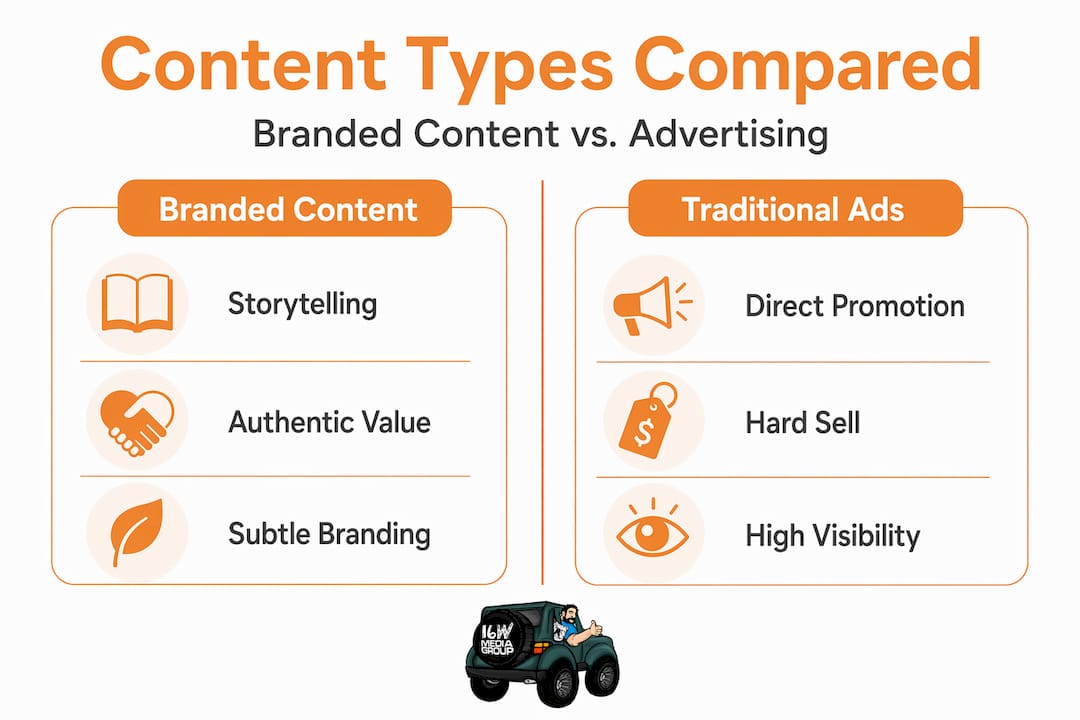
Content marketing drives pipeline. Branded content builds relationships. Both have value, but they serve different parts of a brand’s long-term strategy. Mixing them up is one of the most common and costly mistakes marketing teams make.
Why branded content matters more in 2026
The data on branded content effectiveness is hard to ignore. For Coach’s Gen Z marketing push, branded content delivered a 60% increase in brand awareness and a sixfold increase in consumer consideration. Those are not metrics you generate with display ads.

The broader industry has noticed. Over 70% of marketers now prioritize audience relevance and content quality over publishing frequency. Volume is out. Substance is in. That shift reflects a maturation in how brands understand attention. Attention is finite, and interrupting someone 12 times with a banner ad does not build trust. One genuinely useful piece of content can.
Dove’s 2026 campaign illustrates what authenticity at scale looks like. Instead of polished testimonials, the brand pulled unedited Reddit reviews directly from consumers and turned them into advertising. The result was over 1 billion impressions and a measurable sales uplift. The honesty of the format did what a traditional campaign could not.
Pro Tip: Prioritize brand stories that would stand on their own without your logo attached. If the content only works because of the brand name, it is not branded content. It is an advertisement.
There is also an emerging SEO dimension. Generative search engines are increasingly surfacing content with unique human perspectives and real proof points over generic, keyword-stuffed pages. Branded content built around authentic voices and genuine brand narratives is naturally better positioned for this environment.
Branded entertainment, influencer partnerships, and AI impact
Branded content and branded entertainment are often used interchangeably, but they are not the same thing. Branded content is the broader category. Branded entertainment is a subset where entertainment itself is the delivery mechanism: think scripted series, music, film partnerships, or live events where the brand sponsors or co-creates the narrative arc.
Influencer partnerships fall firmly under branded content when they are done right. The difference between a strong influencer collaboration and a forgettable one comes down to authenticity. Lenovo’s 2026 campaign with David Beckham worked because it focused on everyday routines and lifestyle rather than abstract AI capabilities. The technology was present, but the human story came first.
Here is how to run creator partnerships that actually produce branded content rather than glorified ads:
- Choose creators based on values alignment, not just follower count. An audience of 50,000 highly engaged people in your market outperforms 2 million passive scrollers.
- Brief, do not script. Give the creator the brand context, the emotional tone, and the core message. Let them find the words.
- Involve your brand team early in production. Early production integration prevents the scenario where your brand feels bolted on at the end.
- Plan for the long term. One-off partnerships produce spikes. Ongoing relationships with creators build sustained brand association.
- Measure sentiment and engagement depth, not just reach. Comments, saves, and shares signal that the content resonated, not just that it was seen.
On AI: the temptation to generate branded content at scale with AI tools is real, but the risk is significant. AI-written marketing content is increasingly invisible to generative search engines because it lacks the unique human viewpoints and proof points those engines prioritize. AI can support research, structure, and distribution. The voice and the story must stay human.
Pro Tip: Use AI to analyze audience sentiment and identify story angles your competitors are missing. Use human writers to execute the story. That combination outperforms either alone.
How to create branded content that actually works
Building a branded content strategy starts with a question most brands skip: what does our audience care about that intersects with what we stand for? The intersection of those two things is where every strong branded content idea lives.
Once you have that intersection, the execution steps follow a clear path.
Define your format and platform based on goals
Short-form video works for emotional punch and social sharing. Long-form editorial builds authority and search visibility. Podcasts create habitual engagement and deep brand association over time. Choose based on where your audience actually spends time, not where your team feels comfortable producing. The types of media strategies you use to distribute branded content matter as much as the content itself.
Measure what actually matters
Traditional KPIs like impressions and click-through rates are weak signals for branded content performance. The metrics that matter are engagement rate, content saves and shares, branded search volume growth over time, and qualitative sentiment from comments and community conversations. Dove tracked search ranking improvements alongside sales data as proof that the Reddit reviews campaign moved brand consideration, not just awareness.
Give up some control
This is the step most brand marketers resist. Authentic branded content sometimes means publishing user-generated content you did not write, partnering with creators who speak in their own voice, and accepting that the brand story will be told imperfectly. Imperfect and human will outperform perfect and corporate every time. Authentic storytelling requires giving up control to earn genuine audience connection.
Common pitfalls to avoid when executing branded content campaigns:
- Leading with the product. If the first thing your audience encounters is your product, you have made an ad, not branded content.
- Ignoring distribution. Great content that no one sees is a wasted investment. Build the distribution plan before you build the content.
- Misaligning the creator’s audience. A creator whose audience does not overlap with your target market cannot deliver brand consideration, only impressions.
- Skipping community channels. Platforms like Reddit, niche Facebook groups, and local publications are where brand loyalty is actually built, not just the mainstream feeds.
- Treating it as a one-time campaign. Branded content builds equity through consistency. One piece is a test. A year of consistent storytelling is a strategy.
My honest take on where branded content goes wrong
I have watched brands pour significant budgets into branded content campaigns that produced almost no lasting impact. The pattern is almost always the same. The brand briefed an agency or a creator, approved something that looked great in a presentation, published it, and then measured it like a paid ad. When the numbers did not match expectations, they wrote off branded content as ineffective.
What they actually wrote off was their own execution. In my experience, the brands that see real return from branded content are the ones willing to sit with discomfort. They let creators speak without a legal review of every sentence. They publish community feedback that is occasionally unflattering. They tell stories that elevate local community voices even when the story is not perfectly on-brand.
The other thing I have learned is that measurement kills more branded content programs than bad creative does. When you apply direct-response metrics to a brand-building medium, you will always conclude it is not working. The shift is to measure brand health indicators over 90-day windows: unprompted brand recall, search volume for your brand name, sentiment in community conversations. Those numbers tell the real story.
Businesses that stick with branded content long enough to let it compound are the ones that come to own their category in the audience’s mind. That is not a small thing.
— Mike
Build your branded content strategy with 16wmediagroup
Understanding what branded content is represents the first step. Executing it at a level that actually shifts brand perception requires the right media infrastructure, community connections, and content expertise. That is exactly where 16wmediagroup operates.
16wmediagroup works with businesses in competitive local markets like Tampa to build branded content strategies that span podcasts, community publications, digital media, and regional advertising campaigns. Their team helps you identify the story worth telling, match it to the right format, and distribute it through channels where your audience genuinely pays attention. Whether you are starting from scratch or refining an existing approach, the campaign planning resources and full-service media offerings at 16wmediagroup give your branded content the reach and resonance it deserves. Reach out directly to get a media plan built around your brand’s specific goals.
FAQ
What is the simple definition of branded content?
Branded content is storytelling created by or in partnership with a brand that focuses on providing genuine value, entertainment, or utility to an audience rather than directly promoting a product. The brand is present in the narrative but does not function as the primary message.
How is branded content different from content marketing?
Content marketing targets SEO and lead generation goals, building a pipeline toward direct sales. Branded content focuses on long-term emotional connection and brand affinity, with success measured in audience trust and brand equity rather than conversions.
What are strong examples of branded content?
Dove’s 2026 Reddit reviews campaign and Coach’s Gen Z video series are two of the most cited branded content examples today. Both prioritized authentic audience voices and emotional storytelling over product features and generated measurable lifts in brand consideration.
Does branded content work for small and local businesses?
Yes. Branded content works at any scale when it is grounded in a genuine community story. Local businesses often have an advantage because their stories are inherently specific, personal, and credible to a local audience in ways that national brands struggle to replicate.
How do you measure branded content success?
Measure branded search volume growth, engagement depth (shares, saves, comments), sentiment in community conversations, and brand recall in audience surveys over 90-day windows. Applying click-through and conversion metrics to branded content produces misleading results because those metrics were built for direct-response campaigns.