

A brand persona is defined as a fictional character representing your brand’s voice, tone, and personality to ensure consistent, authentic communication across every marketing channel. Think of it as giving your business a human face. Marketers and small business owners who understand this concept gain a concrete tool for making their messaging feel personal, not corporate. According to Shopify’s brand persona guide, a brand persona functions as an internal tool that keeps communication consistent across teams and touchpoints. The industry also refers to this concept as a brand character or brand voice profile, but “brand persona” is the standard term used across marketing practice today.
What is a brand persona and how does it work?
A brand persona is the practical execution of your brand’s personality traits in real communication and behavior. It goes beyond abstract descriptors like “trustworthy” or “playful.” A complete persona defines your brand’s attitude and emotional stance across every touchpoint, from social media captions to sales emails to customer service scripts.
The persona acts as a mental shorthand for everyone on your team. When a copywriter, a sales rep, and a customer service agent all reference the same persona, their output sounds like it comes from one coherent voice. Without that shared reference, your brand can sound like three different companies depending on who wrote the message.

A strong persona captures more than tone. It includes your brand’s perspective on its industry, its emotional relationship with customers, and the specific language patterns it uses or avoids. Shopify describes this as a tool that serves both internal alignment and external authenticity.
How does a brand persona differ from brand personality and customer personas?
These three concepts are related but serve different functions. Confusing them leads to inconsistent messaging and wasted effort.
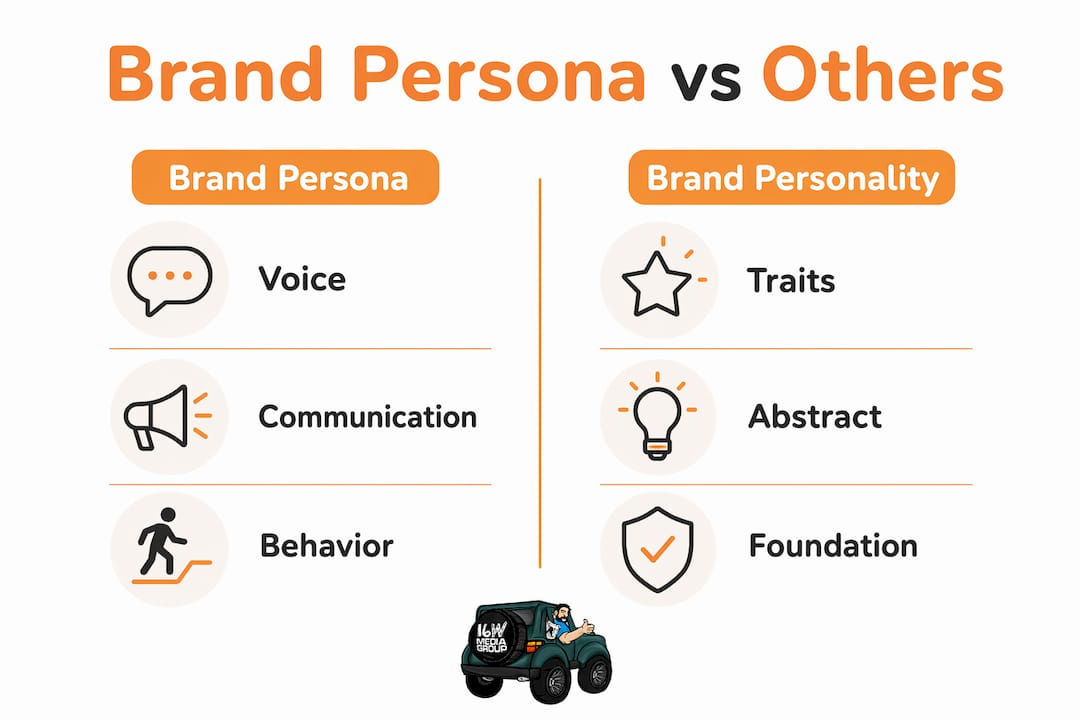
Brand personality is the set of abstract human traits your brand embodies. It is the raw material. Examples include warmth, confidence, wit, or authority. These traits live in your brand guidelines as adjectives.
Brand persona is what happens when those traits get put to work. Brand personality is abstract traits, while brand persona is the execution of those traits in actual communication. The persona is the behavioral tool. It answers the question: “How would our brand actually speak in this situation?”
Customer personas are entirely different. They represent your audience, not your brand. A customer persona is a fictional profile of your ideal buyer, built from demographic data, behavioral patterns, and motivations. Your brand persona speaks. Your customer persona listens.
Here is a quick breakdown of the distinctions:
- Brand personality: Abstract traits (e.g., bold, empathetic, authoritative)
- Brand persona: The character that expresses those traits in content and behavior
- Customer persona: A profile of your target buyer, used to shape messaging strategy
- Brand identity: The visual and verbal system (logo, colors, typography, tagline) that represents the brand
Understanding these differences matters because each tool solves a different problem. Brand personality sets the direction. Brand persona executes it. Customer personas tell you who you are speaking to. Brand identity shows what you look like. Using them interchangeably produces messaging that feels scattered and untrustworthy.
Pro Tip: Create your brand persona after you have defined your brand personality. Trying to build the character before you know the traits is like casting an actor before you have written the script.
Why is a brand persona essential for business success in 2026?
A brand persona increases recognition and loyalty by giving your business a consistent human identity that customers can connect with emotionally. Product features can be copied. A genuine character cannot.
Brand personas increase brand recognition and loyalty by creating a human-like identity that goes beyond what you sell. This matters most in crowded markets where multiple businesses offer similar products at similar prices. The brand that feels like a person wins the relationship.
“Small businesses benefit greatly from brand personas by becoming memorable despite budget constraints. Personality is often the key differentiator.”
For B2B companies, this effect is even more pronounced. Buyers in business markets make decisions over longer cycles and with more stakeholders involved. A consistent, recognizable brand character builds the familiarity that shortens those cycles. The role of branding in competitive markets shows that differentiation through character, not just capability, is what separates market leaders from commodities.
A brand persona also supports internal alignment. When your marketing team, sales team, and customer service team all reference the same character, every customer interaction reinforces the same impression. That consistency compounds over time into genuine brand equity.
For small business owners specifically, a defined persona removes the guesswork from content creation. You stop asking “What should we post?” and start asking “What would our brand character say about this?” That shift alone speeds up content production and improves quality.
What are the key steps to create an effective brand persona?
VistaPrint’s brand persona framework outlines a six-step process that smaller teams can complete in 1–2 weeks. That timeline is realistic if you treat each step as a focused working session rather than an ongoing committee discussion.
Understand your audience. Study your existing customers. Look at the language they use, the problems they describe, and the values they express. Your persona should feel natural to the people you serve.
Define your mission and vision. Your persona must reflect what your business stands for. A company built on community connection should not adopt a persona that feels cold or transactional.
Select three to five core personality traits. Choose traits that are authentic to your team and culture. Anchor your persona in proven company strengths and real team behaviors to avoid inauthenticity. If your team is genuinely enthusiastic and direct, build from that.
Build a voice and tone guide. Document how your persona speaks. Include word choices it favors, phrases it avoids, and how its tone shifts between contexts (e.g., warmer in social media, more precise in technical content).
Create an avatar. Give the persona a name, a visual reference, and a short biography. This makes the character concrete and easier for team members to reference when writing or designing.
Test and iterate. Run the persona through real content scenarios. Have team members write sample posts, emails, or scripts using the persona. Collect feedback and refine before rolling it out across all channels.
Pro Tip: Test your persona against three real customer interactions from the past month. If the persona’s voice would have felt out of place in those conversations, revise the traits before you finalize anything.
What are examples of brand personas and how do they shape marketing?
Brand personas fall into recognizable archetypes, each producing a distinct communication style and emotional effect. The archetype you choose shapes every piece of content your brand produces.
The friendly advisor persona speaks with warmth and patience. It uses plain language, avoids jargon, and frames every interaction as a helpful conversation. This archetype works well for financial services, healthcare, and education brands where customers feel uncertain or vulnerable.
The bold challenger persona speaks with confidence and edge. It challenges conventional thinking, uses provocative language, and positions the brand as a disruptor. This archetype suits brands in fitness, technology, and lifestyle categories where customers want to feel part of a movement.
The expert authority persona speaks with precision and depth. It uses industry terminology correctly, backs claims with data, and positions the brand as the most knowledgeable voice in the room. This archetype fits professional services, B2B technology, and consulting firms.
Here is how persona type shapes content across channels:
| Channel | Friendly advisor | Bold challenger | Expert authority |
|---|---|---|---|
| Social media | Conversational, emoji-friendly | Provocative, short, punchy | Data-driven, insight-led |
| Email subject lines | Warm and direct | Attention-grabbing, edgy | Specific and credible |
| Customer service | Patient, reassuring | Energetic, solution-focused | Thorough, precise |
| Ad copy | Empathetic, benefit-led | Bold claims, strong verbs | Evidence-based, detailed |
A brand persona also shapes what your brand does not say. The friendly advisor never sounds dismissive. The bold challenger never sounds apologetic. The expert authority never oversimplifies. These guardrails are just as valuable as the positive guidelines.
Brand persona in marketing extends beyond content tone. It influences the stories you tell, the causes you associate with, and the way you respond to criticism publicly. A well-defined persona makes those decisions faster and more consistent. For local businesses, this consistency across community magazines, podcasts, and regional advertising is what builds the kind of recognition that drives repeat business. 16wmediagroup works with local brands to translate persona frameworks into media strategies that reach high-value audiences across multiple channels.
Pro Tip: Pick one archetype as your primary persona and one secondary trait that adds nuance. A brand that is “expert authority with warmth” is more interesting than a pure archetype and more authentic to most real businesses.
Key takeaways
A brand persona is the single most practical tool for turning abstract brand values into consistent, recognizable communication that builds customer trust over time.
| Point | Details |
|---|---|
| Definition of brand persona | A fictional character representing your brand’s voice, tone, and behavior across all channels. |
| Persona vs. personality | Brand personality is abstract traits; brand persona is how those traits show up in real communication. |
| Business value | Consistent personas build recognition, loyalty, and emotional connection beyond product features. |
| Six-step creation process | Start with audience research, define traits, build a voice guide, create an avatar, then test. |
| Authenticity requirement | A forced or performative persona damages trust faster than having no persona at all. |
Why I think most businesses skip the most important step
Most brand persona guides focus on the creation process. Few talk about what happens after you build one. In my experience working with local businesses and marketing teams, the persona gets created, filed in a Google Doc, and forgotten within six months.
The real value of a brand persona shows up in the maintenance, not the creation. Regularly auditing and updating your brand persona during major business shifts keeps it relevant and prevents the drift that makes brands feel inconsistent over time. A business that adds a new service line, enters a new market, or shifts its customer base needs to revisit the persona. The character should grow with the company.
The other mistake I see constantly is building a persona that reflects the brand owners’ aspirations rather than their actual culture. A team of five people who communicate bluntly and move fast should not build a persona that sounds warm and unhurried. Customers will meet your real team eventually. When the persona and the reality clash, trust breaks down fast. A forced or performative persona alienates customers faster than having no persona at all.
The brands that get this right treat the persona as a living document. They reference it in hiring decisions, content reviews, and campaign briefs. They use it to onboard new team members. They build local brand awareness by making sure every community touchpoint sounds like the same person. That is when a persona stops being a marketing exercise and starts being a genuine competitive advantage.
— Mike
How 16wmediagroup helps you put your brand persona to work
Building a brand persona is one thing. Deploying it consistently across podcasts, community publications, digital campaigns, and regional advertising is another challenge entirely.
16wmediagroup works with local businesses to translate brand personas into media strategies that reach the right audiences across multiple channels. From community magazines to podcast features to targeted regional campaigns, the team builds media plans around your brand’s character, not just your budget. If you are ready to move from a defined persona to a brand that your market actually recognizes, the Tampa branding strategies guide is a strong starting point. You can also explore integrated branding strategy to see how persona-driven messaging works across every channel your customers use.
FAQ
What is a brand persona in simple terms?
A brand persona is a fictional character that represents your brand’s voice, tone, and personality. It gives your business a consistent human identity across all marketing channels.
How is a brand persona different from a customer persona?
A brand persona represents how your brand communicates. A customer persona represents who your ideal buyer is. Both are fictional profiles, but they serve opposite purposes in your marketing strategy.
How long does it take to create a brand persona?
Smaller teams can complete the process in 1–2 weeks using a structured six-step framework that covers audience research, trait selection, voice guidelines, and testing.
Can a brand persona hurt your business?
Yes. A performative persona that does not match real company behavior undermines trust and alienates customers faster than having no persona at all. Authenticity is the non-negotiable foundation.
How often should you update your brand persona?
A brand persona is not a static asset. Review and update it during major business shifts, market expansions, or significant changes in your customer base to keep messaging consistent and relevant.