
An advertising package is defined as a pre-bundled set of marketing services or ad placements sold together under a single agreement, designed to deliver cost-efficiency and measurable results. Rather than buying individual services from separate vendors, you get strategy, creative production, targeting, and reporting wrapped into one coordinated program. Platforms like Google Ads and Facebook Ads Manager are common components within these packages, alongside content creation, SEO, and analytics. For small and medium-sized businesses competing in local markets, understanding the advertising package definition is the difference between scattered ad spend and a system that actually builds customers.
What does an advertising package include?
An advertising package is a pre-bundled set of multiple marketing services sold together, and the components vary by tier but follow a consistent structure. Most packages cover five core areas that work together rather than in isolation.
- Strategy development. Every package worth buying starts with aligning your ad activity to specific business goals, whether that is foot traffic, online sales, or lead generation. Without this step, you are paying for activity, not outcomes.
- Creative production. This covers the visuals, ad copy, and messaging that appear across your chosen channels. Higher-tier packages include video production and senior copywriters; starter packages typically offer static graphics and basic copy.
- Campaign setup and audience targeting. Targeting methods in advertising packages typically include demographic, geographic, behavioral, and content-based criteria. A Tampa restaurant, for example, would target adults within a 10-mile radius who have shown interest in dining out.
- Ongoing optimization. This is where most businesses underestimate the work involved. Testing ad variations, adjusting bids, and refining audiences happens continuously, not once at launch.
- Reporting and analytics. Effective packages report on business outcomes like qualified leads and revenue, not just impressions and clicks. Clarifying whether reporting includes human analysis or just automated platform metrics is critical to understanding the true value of any package.
Pro Tip: Ask your provider to show you a sample report before signing. If it only shows reach and impressions, push for a version that ties ad activity to actual business results like calls, form fills, or store visits.
What types of advertising packages are available?
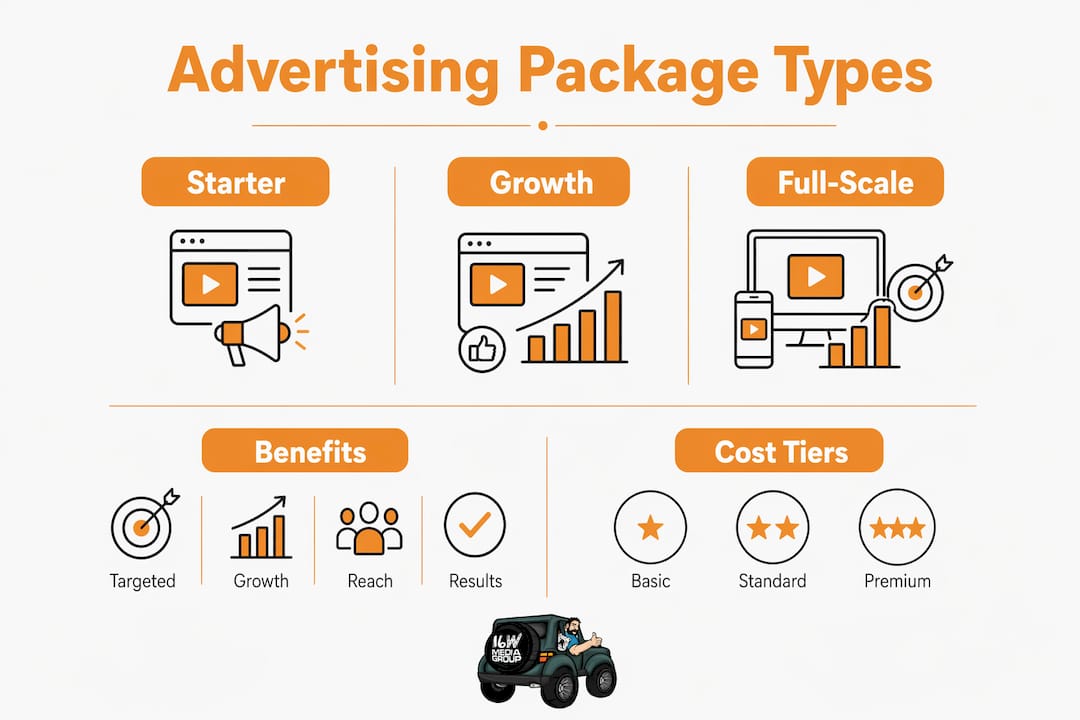
Full-scale digital marketing packages often combine SEO, content marketing, social media management, and paid advertising, but most businesses start at a lower tier and scale up. Here is how the three main types compare.

| Package type | Typical scope | Best for |
|---|---|---|
| Starter | Single platform (e.g., Facebook Ads or Google Ads), basic creative, monthly reporting | New businesses or those testing a single channel |
| Growth | Multichannel coordination, expanded creative assets, A/B testing, bi-weekly reporting | Businesses ready to scale with a consistent budget |
| Full-Scale | SEO, content, paid campaigns, analytics, senior strategist involvement, weekly reporting | Established SMBs with aggressive growth targets |
The critical distinction between these tiers is not just the number of channels covered. It is the depth of strategy and the quality of optimization. A starter package might run your Google Ads campaign, but a full-scale package will test five audience segments, build a landing page, and connect ad performance to your CRM data.
Always request a written scope of work before purchasing any package. Two packages priced identically may include completely different deliverables. One might include conversion API setup for Facebook; another might not. You will not know unless it is in writing.
The types of advertising packages available also extend beyond digital. Community magazines, podcast sponsorships, and regional print placements are bundled into local media packages by agencies like 16wmediagroup, which specialize in connecting Tampa-area businesses with high-value local audiences. Understanding your local media strategies before committing to a package prevents you from overpaying for reach that does not match your customer base.
What are the benefits of advertising packages for small businesses?
The benefits of advertising packages go well beyond saving money on individual services. The real advantage is structural: you get a coordinated system instead of a collection of disconnected tasks.
Coordinated campaigns across multiple channels create synergies that improve qualified lead generation and online sales. When your Facebook ad, your Google search ad, and your community magazine placement all carry the same message to the same audience, the cumulative effect is significantly stronger than any single channel alone. This is the difference between advertising and a growth system.
- Cost-efficiency. Bundled pricing is consistently lower than purchasing each service separately. You also eliminate the coordination overhead of managing three or four separate vendors.
- Operational simplicity. One vendor, one invoice, one point of contact. For a business owner already managing operations, sales, and staff, this matters more than most agencies admit.
- Repeatable growth. A true advertising package transforms ad spend into a repeatable growth engine with measurable results, not just short-term exposure. You build audience data, creative learnings, and targeting precision over time.
- Improved targeting accuracy. Packages that include behavioral and geographic targeting let you reach the right people in your local market without wasting budget on irrelevant audiences.
- Access to professional expertise. You get strategists, designers, and analysts working on your account without hiring them full-time.
Pro Tip: Use the community magazine advertising benefits as a benchmark when evaluating any local package. If a digital-only package cannot demonstrate comparable audience trust and engagement, consider a hybrid approach.
What does an advertising package cost?
Typical monthly costs span three tiers: Starter at $1,000 to $2,500, Growth at $2,500 to $7,500, and Full-Scale at $7,500 to $25,000 or more per month. These figures reflect agency fees and management costs, separate from your actual ad spend on platforms like Google or Meta.
| Tier | Monthly cost range | What drives the price |
|---|---|---|
| Starter | $1,000 to $2,500 | Single platform, basic creative, limited reporting |
| Growth | $2,500 to $7,500 | Multichannel, A/B testing, expanded creative assets |
| Full-Scale | $7,500 to $25,000+ | Senior strategists, full-funnel coverage, deep analytics |
Several factors affect where your package lands within these ranges. The number of platforms covered, the level of creative production, the frequency of reporting, and whether the package includes conversion tracking setup all push costs up or down. A package that includes video production and weekly analyst calls will cost more than one with static graphics and a monthly PDF report.
A practical budgeting rule: allocate between 5% and 12% of gross revenue to total advertising spend, then use that figure to determine which tier is realistic. A business generating $500,000 annually has a reasonable advertising budget of $25,000 to $60,000 per year, which comfortably supports a Growth-tier package with ad spend included.
The cost of advertising packages also reflects ongoing investment. An effective advertising package is not a set-it-and-forget-it solution. It requires continual testing of ad variations and audience targeting to meet tangible business outcomes. Businesses that treat a package as a one-time purchase and disengage from the process consistently underperform those that stay actively involved.
How to choose and implement an advertising package for local markets
Selecting the right package starts before you talk to any agency. You need to know what you are trying to achieve, because the right package components depend entirely on your business goals, not on what sounds impressive in a sales deck.
- Define your business outcome first. Are you trying to generate leads, drive foot traffic, increase online orders, or build brand recognition in a specific neighborhood? Each goal requires different channels and creative approaches. A media planning checklist helps you connect package components to specific outcomes before you commit.
- Evaluate package components against your goal. A package heavy on brand awareness content is wrong for a business that needs immediate lead generation. Match the deliverables to the outcome, not the other way around.
- Set clear expectations with your provider. Agree on KPIs, reporting frequency, and what success looks like at 30, 60, and 90 days. Vague agreements produce vague results.
- Prioritize local geographic and behavioral targeting. For SMBs in markets like Tampa, targeted media campaigns that combine geographic radius targeting with behavioral data consistently outperform broad demographic targeting alone.
- Plan for continuous monitoring. Review performance data monthly at minimum. Ask your provider what they changed last month and why. Passive clients get passive results.
- Use agency expertise when available. Agencies that specialize in local markets bring audience data and channel relationships that take years to build independently. That knowledge is part of what you are paying for.
Pro Tip: Request a CPC-based pricing model for any sponsored content or newsletter inclusions within your package. It aligns the agency’s incentive with your actual traffic results rather than just impressions delivered.
Key takeaways
An advertising package delivers the most value when treated as a strategic growth system, not a task bundle. Businesses that define clear outcomes, review written scopes, and stay actively involved in optimization consistently outperform those that buy and disengage.
| Point | Details |
|---|---|
| Definition matters | An advertising package is a pre-bundled set of services sold together for cost-efficiency and coordinated results. |
| Components drive value | Strategy, creative, targeting, optimization, and outcome-based reporting are the five core elements to verify. |
| Three clear tiers exist | Starter, Growth, and Full-Scale packages differ in scope, channel depth, and strategic involvement. |
| Cost requires active budgeting | Allocate 5% to 12% of gross revenue to advertising, then match that budget to the appropriate tier. |
| Ongoing involvement is required | Packages that receive active client participation in optimization consistently outperform passive arrangements. |
Why most businesses get less than they pay for
I have reviewed advertising packages for local businesses across a wide range of budgets, and the pattern is almost always the same. The business owner signs a package, gets excited about the launch, and then checks in three months later wondering why the results are flat. The package was not the problem. The approach was.
Most small business owners treat an advertising package the way they treat a utility bill. You pay it, you expect it to work, and you do not think about it again until something breaks. That mindset is exactly what separates businesses that grow from those that plateau. Outcome-focused reporting is what separates effective packages from simple ad management services, and you only get that reporting if you ask for it and hold your provider accountable to it.
The other mistake I see constantly is buying a package based on channel count rather than strategic depth. A package covering five platforms with shallow execution on each is worth less than a focused two-channel package with rigorous testing and real audience data. More is not better. Depth is better.
My honest recommendation: before you sign anything, ask your provider to walk you through the last three months of results for a comparable client. Not a case study. An actual performance review. If they cannot or will not do that, you have your answer.
— Mike
Ready to build a local advertising package that actually works?
16wmediagroup works with small and medium-sized businesses across Tampa and surrounding markets to design advertising packages built around specific local growth goals. Whether you need a focused single-channel starter program or a full-scale media plan combining digital, podcast, and community publishing, the team at 16wmediagroup builds packages around your outcomes, not a standard template.
Start with the local advertising campaign guide to map your goals before your first conversation with a media partner. If you are ready to talk through your options now, explore the full range of media and advertising services or reach out directly to start building a package that fits your market and your budget.
FAQ
What is an advertising package in simple terms?
An advertising package is a bundled set of marketing services sold together under one agreement, typically including strategy, creative production, audience targeting, and performance reporting. It replaces the need to hire and manage multiple separate vendors.
What does an advertising package typically cost per month?
Monthly costs range from $1,000 to $2,500 for starter packages, $2,500 to $7,500 for growth packages, and $7,500 to $25,000 or more for full-scale packages, separate from actual ad platform spend.
How do I know if an advertising package is right for my business?
If you are spending money on ads without a clear strategy, consistent creative, or outcome-based reporting, a structured advertising package will almost always produce better results than managing individual services separately.
What is the difference between a starter and a full-scale advertising package?
A starter package focuses on a single platform with basic creative and monthly reporting, while a full-scale package covers multiple channels including SEO, content, and paid ads, with senior strategist involvement and detailed analytics tied to revenue outcomes.
Can advertising packages include traditional media like print or podcasts?
Yes. Agencies like 16wmediagroup bundle traditional media placements, including community magazines and podcast sponsorships, alongside digital channels to create local advertising packages that reach audiences across multiple touchpoints.