

Brand positioning is defined as the deliberate strategic process of establishing a unique and defensible place for a brand in the minds of a specific target audience, relative to competing alternatives. It is not a tagline, a logo refresh, or a mission statement rewrite. Brand positioning is the single most important strategic decision a business makes because it determines how customers perceive your value compared to every other option they have. Frameworks from Kissmetrics and SocialRevver confirm that without deliberate positioning, brands default to generic messaging and lose the ability to compete on anything other than price.
What is brand positioning and why does it matter?
Brand positioning is the act of shaping how customers think about your brand relative to alternatives. Every brand already has a position in the market whether it chose one or not. The difference between a thriving brand and a struggling one is often whether that position was designed deliberately or left to chance.
The importance of brand positioning shows up directly in business performance. Without clear positioning, marketing efforts lack direction and produce expensive but ineffective campaigns. When your positioning is sharp, every dollar you spend on advertising reinforces the same idea in the customer’s mind. That compounding effect is what builds brand equity over time.

Consider two local law firms in the same city. One markets itself as “experienced, trusted, and client-focused.” The other positions itself as the only firm in the region that exclusively represents small business owners in contract disputes. The second firm has a position. The first has adjectives. Adjectives do not win markets. Specificity does.
What are the core components of a brand positioning framework?
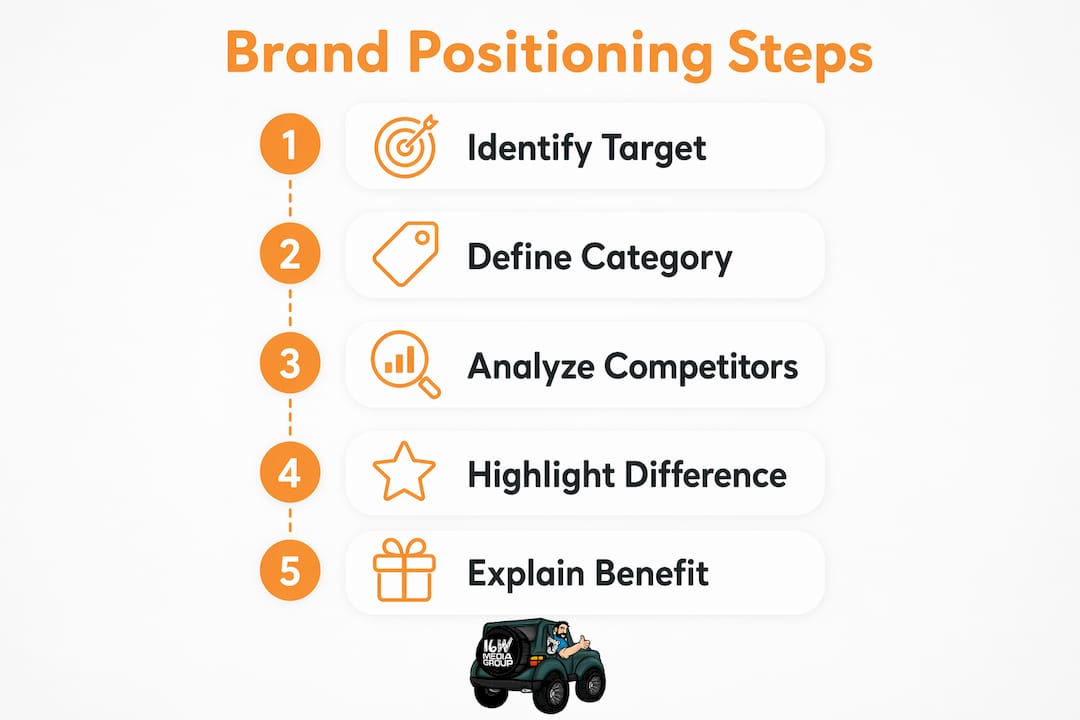
A positioning framework is built from five interlocking components. Each one answers a specific question your customer is already asking.
- Target customer: Who exactly are you serving? The more specific, the better. “Small business owners in Tampa with under 20 employees” beats “entrepreneurs.”
- Category: What space do you compete in? This sets the frame of reference for the customer.
- Competitive alternatives: What would your customer use if you did not exist? This is not always a direct competitor. Sometimes it is a workaround or doing nothing.
- Unique point of difference: What do you do that no alternative does, or does as well?
- Reason to believe: What proof makes your claim credible? Certifications, case studies, proprietary methods, and track records all qualify.
SocialRevver offers a positioning statement format that captures all five components cleanly: “We are the ONLY [Category] that [Unique Action] for [Specific Audience] so they can [Specific Win].” This format forces you to narrow your audience deliberately and commit to a single point of difference. Most brands resist this because it feels like leaving customers out. The reality is that specificity attracts the right customers far more reliably than broad appeals.
Pro Tip: Write your positioning statement in one sentence. If you need two sentences, your position is not clear yet. Clarity is the test.
The table below shows how features, benefits, and points of difference relate to each other and why conflating them creates weak positioning.
| Element | What it describes | Common mistake |
|---|---|---|
| Feature | What the product does | Listing features as differentiation |
| Benefit | What the customer gains | Stopping at generic benefits like “saves time” |
| Point of difference | Why you beat alternatives | Claiming differences competitors also claim |
| Reason to believe | Proof the claim is true | Making claims without supporting evidence |
Conflating features with differentiation leads to generic messaging that fails to distinguish a brand. A feature is a fact about your product. A point of difference is a fact about your product that matters to your customer and that your competitors cannot credibly claim.
How does brand positioning differ from brand identity and brand strategy?
These three terms are used interchangeably in most marketing conversations. They are not the same thing, and confusing them leads to real strategic failures.
Positioning dictates strategic intent. It is the decision about where and why your brand competes. Brand identity is the expression of that intent through logo, color palette, typography, tone of voice, and visual language. Brand strategy is the broader plan that includes your purpose, values, growth goals, and the role positioning plays in achieving them.
Think of it this way:
- Brand positioning answers: “Why should this specific customer choose us over every alternative?”
- Brand identity answers: “How do we look and sound when we show up in the market?”
- Brand strategy answers: “Where are we going and how does the brand help us get there?”
“Positioning is what you do to the mind of the prospect, not your product. Framing the offering so the right customers immediately understand why alternatives fall short.” — Clarigital Brand Positioning Strategy
When a company redesigns its logo without revisiting its positioning, it changes how it looks without changing what it means. Customers notice the inconsistency even if they cannot name it. A brand that looks premium but positions itself on low price creates cognitive dissonance. That dissonance erodes trust faster than any competitor can.
The most common misalignment 16wmediagroup sees in local markets is a business with a polished visual identity and zero clarity on its actual point of difference. The brand looks good but says nothing specific. That is a positioning problem, not a design problem.
What are common mistakes in brand positioning?
Most positioning mistakes fall into predictable patterns. Recognizing them early saves significant time and money.
-
Treating positioning as a tagline. A tagline is a marketing output. Positioning is the strategic input that makes the tagline mean something. “Just Do It” works because Nike’s positioning as the brand for serious athletic performance is already embedded in the customer’s mind.
-
Making claims that are not operationally true. A positioning statement is an output. The strategy behind it must be defensible and commercially sustainable. If you claim to be the fastest, you need operations, staffing, and systems that actually deliver speed. Positioning that outpaces your capabilities destroys credibility.
-
Choosing a position that competitors can copy overnight. Sustainable positioning is built on capabilities, relationships, or knowledge that take time to replicate. Price is the easiest position to copy. It is also the least defensible.
-
Drifting from the position under pressure. When sales slow, the instinct is to broaden the appeal. This almost always weakens the position further. Consistency over time is what builds the cognitive association that makes positioning valuable.
Pro Tip: Run a simple test. Ask five customers why they chose you over alternatives. If you get five different answers, your positioning has not landed yet.
The deeper issue is that many business owners treat positioning as a one-time marketing exercise. Positioning needs periodic stress-testing against market shifts, competitor moves, and internal changes. A position that was defensible three years ago may be table stakes today.
How to develop an effective brand positioning strategy
Building a positioning strategy that holds up in competitive markets follows a clear sequence. Skipping steps produces a statement that sounds good internally but fails externally.
-
Research your audience with specificity. Conduct interviews, not surveys. Surveys tell you what customers say. Interviews tell you what they mean. Identify the specific outcome your best customers are trying to achieve and the alternatives they considered before choosing you.
-
Map the competitive field honestly. List every real alternative your target customer would consider, including doing nothing. Identify what each alternative does well and where it falls short. Your point of difference lives in that gap.
-
Audit your internal capabilities. Your positioning must be grounded in what you can actually deliver today, not what you aspire to deliver. Honest capability assessment prevents positioning that overpromises.
-
Write the positioning statement. Use the SocialRevver format or a comparable structure. The statement is internal. It guides decisions. It is not necessarily the copy that appears in your ads.
-
Align the brand character. Your tone, visual identity, and messaging must reflect the position. A brand positioned as the approachable expert for first-time homebuyers should not communicate like a Wall Street investment bank.
-
Apply positioning across all decisions. Positioning directly influences product development, pricing, messaging, and marketing campaigns. Every decision should be filtered through the question: “Does this reinforce our position?”
-
Revalidate on a schedule. Set a calendar reminder to revisit your positioning every 12–18 months. Markets shift. Competitors move. Your position needs to move with them or hold firm with intention.
The table below shows how positioning informs specific business decisions across departments.
| Business area | How positioning guides it |
|---|---|
| Pricing | Sets the price tier that matches the perceived value of your position |
| Product development | Prioritizes features that reinforce the point of difference |
| Marketing campaigns | Determines which channels and messages reach the right audience |
| Sales conversations | Gives the team a clear answer to “why us over them?” |
| Hiring | Attracts people who believe in and can deliver the positioned promise |
Pro Tip: Use your positioning statement as a filter in your next campaign brief. If a creative concept does not reinforce your point of difference, cut it before it ships.
For local businesses competing in markets like Tampa, branding in competitive markets requires positioning that connects to community context, not just product features. Brands that understand their neighborhood, their customer’s daily life, and the local alternatives they face build positions that national competitors cannot replicate.
Key takeaways
Effective brand positioning is the single strategic decision that determines whether your marketing builds equity or burns budget.
| Point | Details |
|---|---|
| Positioning is strategic, not cosmetic | It shapes customer perception at the decision level, not the aesthetic level. |
| Five components build the framework | Target customer, category, alternatives, point of difference, and reason to believe must all align. |
| Identity expresses what positioning decides | Redesigning your logo without revisiting positioning changes looks without changing meaning. |
| Operational truth is non-negotiable | Claims must reflect what you can actually deliver or credibility collapses. |
| Revalidation keeps positioning relevant | Review your position every 12–18 months to stay ahead of market and competitor shifts. |
Why most brands never commit to a real position
I have worked with dozens of local businesses that had strong products, good teams, and real customer loyalty. The ones that struggled to grow almost always had the same problem: they had never made a deliberate choice about what they stood for relative to alternatives.
The uncomfortable truth is that positioning requires saying no. No to the customer segment that is not your best fit. No to the product feature that does not reinforce your difference. No to the campaign idea that sounds exciting but dilutes your message. Most business owners find that kind of discipline genuinely difficult, especially when revenue pressure is real.
What I have seen work is treating the positioning statement as a decision filter, not a marketing document. When a pricing question comes up, the position answers it. When a new service idea surfaces, the position vets it. When a campaign brief lands on your desk, the position edits it. That is when positioning stops being a strategy exercise and starts being a commercial asset.
The brands that build consistent positioning over time do not just win more customers. They win the right customers, at better margins, with lower acquisition costs. That compounding effect is what separates brands that grow from brands that grind.
— Mike
How 16wmediagroup helps you turn positioning into market presence
Strong positioning only creates results when it reaches the right audience through the right channels. That is where execution matters as much as strategy.
16wmediagroup works with local businesses and regional brands to translate deliberate positioning into media plans that actually land. From community magazines and podcasts to targeted digital campaigns, every channel is selected to reinforce the brand’s specific point of difference with the audience most likely to act. If you are ready to stop running campaigns that feel scattered and start building a presence that compounds, the local advertising campaign planning guide is the right next step. You can also explore the full range of media and branding services 16wmediagroup offers to local and regional brands ready to compete with clarity.
FAQ
What is the brand positioning definition in simple terms?
Brand positioning is the strategic process of defining how your brand occupies a specific, unique place in the mind of your target customer compared to competitors. It is the answer to the question: “Why should this customer choose us over every alternative?”
How is brand positioning different from a tagline?
A tagline is a marketing output. Brand positioning is the strategic foundation that makes a tagline meaningful. Nike’s “Just Do It” works because the positioning behind it is already established in the customer’s mind.
What are the five components of a brand positioning framework?
The five components are target customer, category, competitive alternatives, unique point of difference, and reason to believe. All five must align for the positioning to be credible and defensible.
Why is brand positioning important for small businesses?
True brand differentiation hinges on perceived unique value, not product features alone. For small businesses, clear positioning reduces wasted ad spend and attracts the right customers at better margins.
How often should you revisit your brand positioning strategy?
Positioning is not set-and-forget. Review your position every 12–18 months or whenever a significant competitor move, market shift, or internal capability change occurs.