
Advertising’s role in community growth is to create meaningful local connections that generate both economic prosperity and lasting neighborhood trust. This goes well beyond selling products. When done right, advertising acts as a tool for community development, building the social fabric that keeps local economies healthy. Community marketing strategies deliver 250% ROI and cost 62% less per lead than traditional advertising. That gap is too large for any community leader or local business owner to ignore. The shift from broadcast-style ads to community-based strategies is the defining advertising trend of 2026.
What is the role of advertising in community growth?
Advertising drives community growth by connecting local businesses to residents in ways that build trust, generate referrals, and circulate money within the neighborhood economy. The industry term for this approach is community marketing, which refers to advertising strategies designed to engage existing and potential customers through shared values and local identity rather than pure product promotion.
The impact of advertising on community health shows up in three distinct ways:
- Economic circulation: Local ad spending keeps dollars in the neighborhood. When a Tampa restaurant advertises in a community magazine rather than a national platform, the revenue stays regional.
- Social trust: Ads that reflect community values signal that a business is a neighbor, not just a vendor. That distinction matters enormously to local buyers.
- Civic visibility: Advertising surfaces local businesses that residents might otherwise miss, strengthening the overall commercial ecosystem.
90% of customers are influenced more by community content than by brand ads. That statistic reframes the entire purpose of local advertising. It means your neighbors’ opinions and your presence in local media carry more weight than any polished national campaign.
What are the core benefits of advertising for local communities?

The benefits of advertising in neighborhoods extend far beyond brand awareness. The most measurable benefit is customer lifetime value. Community-referred customers show 2.3x higher lifetime value than those acquired through traditional paid channels. That multiplier compounds over 18–36 months, meaning the return grows the longer you invest in community relationships.
Cost efficiency is the second major benefit. Community advertising costs 62% less per lead than traditional methods. For a local business spending $2,000 per month on ads, that difference could mean generating three times the leads for the same budget.
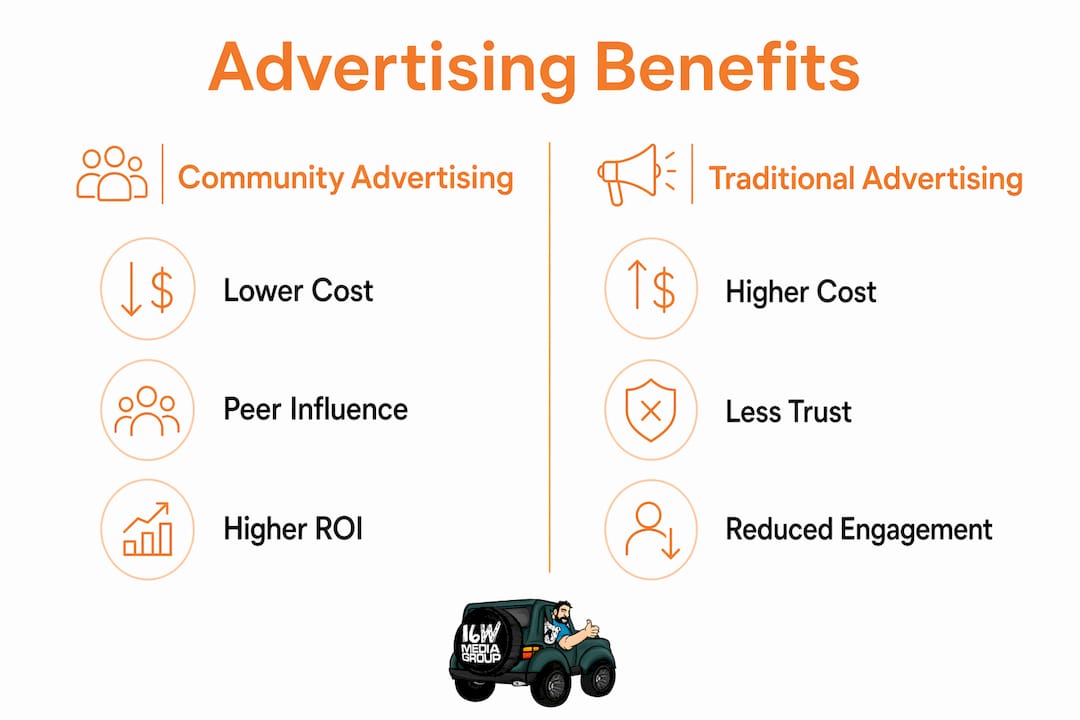
The social benefits are equally significant. Peer recommendations within a neighborhood carry psychological weight that no billboard can replicate. When a local business earns genuine goodwill through community-aligned advertising, that goodwill spreads through word of mouth, social media shares, and local referral networks.
There is one nuance worth addressing directly. Ad saturation erodes goodwill fast. Flooding a neighborhood with repetitive messaging produces diminishing returns and can actively damage your reputation.
Pro Tip: Set a frequency cap on digital ads targeting local zip codes. Seeing the same ad more than three times in a week signals desperation, not authority. Rotate creative every 30 days to keep messaging fresh and relevant.
How do community marketing strategies compare with traditional advertising?
Community marketing and traditional advertising solve the same problem through fundamentally different mechanisms. Traditional advertising broadcasts a message to a mass audience and hopes for conversion. Community marketing builds relationships first and converts as a byproduct.
The data on this comparison is decisive. Review the key differences below:
| Feature | Traditional Advertising | Community Marketing |
|---|---|---|
| Cost per lead | Higher baseline cost | 62% lower per lead |
| Customer lifetime value | Standard LTV | 2.3x higher LTV |
| ROI | Variable, often below 100% | Average 250% ROI |
| Trust mechanism | Brand authority | Peer recommendation |
| Content source | Brand-produced | User-generated and local |
| Longevity | Stops when budget stops | Compounds over time |
Traditional advertising also faces a structural problem: banner blindness. Modern consumers have trained themselves to ignore display ads, pre-roll video, and generic social media promotions. Humanized, locally invested ad budgets consistently outperform generic traditional advertising. This is not a marginal difference. It reflects a fundamental shift in how people process commercial messages.
User-generated content and peer influence are the engines of community advertising. When a local business owner in St. Petersburg sponsors a neighborhood event and documents it authentically, the resulting social posts, photos, and reviews generate organic reach that no paid placement can buy. That content also lives permanently online, continuing to influence new residents long after the event ends.
The local media buying versus digital ads decision is not binary. The strongest community advertisers combine both, using local media for trust and digital for precision targeting.
What advertising strategies can local businesses implement for growth?
Practical advertising strategies for local growth follow a specific sequence. Skipping steps wastes budget and produces weak results.
-
Build your organic foundation first. Claim and fully optimize your Google Business Profile. Collect reviews systematically. An optimized Google Business Profile and strong review base lowers paid ad costs by two to three times and improves conversion rates before you spend a single dollar on paid media.
-
Layer AI-powered local ad targeting. Once your organic foundation is solid, add Google Ads with AI-driven targeting. AI-powered Google Ads for local businesses achieve 60% lower cost per acquisition and 25–40% improved return on ad spend when conversion tracking is set up correctly. That means tracking phone calls, direction requests, and form submissions, not just clicks.
-
Activate neighborhood platforms and local media. Platforms like Nextdoor and community magazines reach residents who are actively looking for local recommendations. A community-based advertising strategy that combines digital neighborhood platforms with print community publications creates multiple touchpoints within the same geographic audience.
-
Create content that reflects community identity. Sponsor local events. Feature real customers in your ads. Highlight neighborhood stories. This approach aligns with the shift toward participatory advertising, where ads enhance civic inclusion rather than interrupt it.
-
Measure and iterate monthly. Track cost per lead, conversion rate by channel, and customer lifetime value by acquisition source. Cut channels that underperform after 60 days. Double down on what compounds.
Pro Tip: The most common mistake local businesses make is running paid ads before fixing their Google Business Profile. A prospect who clicks your ad and finds 12 unanswered reviews and an incomplete profile will not convert. Fix the foundation before spending on traffic.
The media planning checklist from 16wmediagroup walks through each of these steps with channel-specific guidance for local markets.
What are the drawbacks of advertising in community settings?
Advertising influence on the local economy cuts both ways. Done poorly, advertising creates friction, not connection. Community leaders and business owners need to understand these risks before scaling any campaign.
The environmental and psychological costs of excessive outdoor advertising are well documented. 71% of residents report worsening visual pollution from billboards, and over 50% link that pollution to stress and neighborhood dissatisfaction. Visual clutter signals commercial exploitation, not community investment. That perception directly undermines the trust that community advertising is supposed to build.
The key risks to manage include:
- Misalignment with community values: An ad that feels tone-deaf to local culture or current events can generate backlash that spreads faster than any positive campaign.
- Frequency fatigue: Overexposure to the same message trains residents to ignore your brand entirely.
- Inauthenticity: Stock photos, generic copy, and national brand templates feel foreign in local contexts. Residents notice immediately.
- Platform mismatch: Advertising on channels your community does not use wastes budget and signals that you do not actually know your neighbors.
Advertising becomes a liability the moment it prioritizes volume over relevance. The most effective local advertisers treat every ad as a conversation, not a broadcast.
Advertising is shifting toward participatory communication that supports civic values and community resilience. That shift is not optional for local businesses. It is the direction the market is moving, and businesses that resist it will find their ad spend producing less return every year. The community magazine advertising benefits model illustrates how print media can humanize ad content in ways that digital alone cannot replicate.
Key takeaways
Community marketing consistently outperforms traditional advertising in ROI, customer lifetime value, and long-term cost efficiency, making it the most effective advertising approach for local business and community growth.
| Point | Details |
|---|---|
| Community marketing ROI | Community strategies deliver 250% ROI and cost 62% less per lead than traditional ads. |
| Customer lifetime value | Community-referred customers generate 2.3x higher lifetime value over 18–36 months. |
| Organic foundation first | Optimizing Google Business Profile before running paid ads reduces ad costs by 2–3x. |
| AI targeting efficiency | AI-powered Google Ads achieve 60% lower cost per acquisition for local businesses. |
| Ad saturation risk | 71% of residents report billboard overload worsens visual pollution and neighborhood satisfaction. |
Why I think most local businesses are advertising in the wrong order
I have worked with enough local business owners to recognize a pattern. They launch paid ads first, then wonder why the results are weak. The real problem is sequence. You cannot buy trust. You have to earn it before you amplify it.
The businesses I have seen grow most consistently in competitive local markets like Tampa start with their organic infrastructure: Google Business Profile, reviews, local partnerships, and community presence. Only after that foundation is solid do they layer paid media on top. At that point, the ads work because the trust already exists. The ad is just a reminder, not an introduction.
Community-led growth is a compounding engine. Unlike static paid media that stops the moment your budget runs out, community advocacy and organic referrals keep generating returns for years. That compounding effect is why the 18–36 month lifetime value numbers look so different from traditional acquisition channels.
The other mistake I see constantly is treating advertising as separate from community engagement. They are the same thing when done right. Every ad is a statement about what your business values. If that statement resonates with your neighborhood, it builds loyalty. If it feels generic or exploitative, it erodes it. The businesses that understand this distinction are the ones still growing five years from now.
— Mike
How 16wmediagroup helps local businesses grow through community advertising
16wmediagroup specializes in exactly the kind of integrated, community-first advertising that this article describes. The team combines AI-powered local targeting with traditional media, community magazines, and podcast-based content to create campaigns that build genuine neighborhood presence. Whether you are a community leader looking to increase local engagement or a business owner ready to move beyond generic digital ads, 16wmediagroup builds local advertising campaigns tailored to your market and your community’s values. Start with the 2026 local advertising best practices guide to see exactly how the strategy comes together for businesses in competitive local markets.
FAQ
What is the role of advertising in community growth?
Advertising drives community growth by connecting local businesses to residents through trust-building, peer referrals, and shared local identity. Community marketing strategies deliver 250% ROI and cost 62% less per lead than traditional advertising.
How does community marketing differ from traditional advertising?
Community marketing builds relationships through peer influence and user-generated content, while traditional advertising broadcasts messages to mass audiences. Community-referred customers show 2.3x higher lifetime value than those acquired through traditional paid channels.
What advertising strategies work best for local business growth?
Start by optimizing your Google Business Profile and collecting reviews, then layer AI-powered Google Ads targeting. An optimized local foundation lowers paid ad costs by two to three times before you spend on traffic.
Can advertising hurt a community if done poorly?
Yes. Over 71% of residents report that excessive billboard advertising worsens visual pollution, and more than 50% link it to stress and neighborhood dissatisfaction. Frequency, relevance, and alignment with community values determine whether advertising builds or erodes local trust.
How does AI improve local advertising results?
AI-powered Google Ads achieve 60% lower cost per acquisition and 25–40% improved return on ad spend for local businesses when conversion tracking is set up to measure local goals like calls, direction requests, and form submissions.