

A multimedia strategy is a coordinated plan that combines video, audio, images, text, and interactive content into a single, unified approach to reach and engage your audience. Unlike single-format campaigns, this approach works because different formats appeal to different senses and learning styles, which means more of your audience actually absorbs your message. Marketing professionals often call this an integrated content strategy or multimedia marketing plan. Both terms describe the same discipline: deliberate, cross-format communication designed to build brand awareness and drive measurable results. This guide breaks down the core components, implementation steps, and measurement frameworks you need to put one to work.
What is multimedia strategy and why does it matter?
A multimedia strategy is defined by three things: the formats you use, the channels you distribute through, and the goals that tie them together. Pull any one of those out and you have a content tactic, not a strategy. The difference matters because tactics produce isolated results while a strategy compounds them.
The core components
Every effective multimedia content strategy contains four building blocks. First, content formats: video, podcasts, blog posts, infographics, email, and interactive graphics. Second, distribution channels: social media platforms, your website, email lists, and community publications. Third, audience targeting: knowing which formats your specific audience prefers rather than guessing. Fourth, measurable goals that connect content output to business outcomes like leads, sales, or brand recall.

Why businesses need this approach
Integrating multimedia content significantly increases engagement, retention, SEO performance, and conversion rates compared to single-format content. That finding has a direct implication: businesses that publish only blog posts or only social graphics are leaving measurable performance on the table. A local business in Tampa running a community magazine ad alongside a podcast feature and a targeted social campaign will outperform the same business running only one of those channels in isolation. The role of media strategy in business growth is not theoretical. It shows up in the numbers.
Benefits of a multimedia approach
The benefits of a multimedia approach extend well beyond engagement metrics:
- Higher SEO rankings: Search engines reward pages that combine text, video, and images because they signal content depth.
- Broader audience reach: Different people discover content through different channels. Audio reaches commuters. Video reaches visual learners. Text reaches researchers.
- Stronger brand recall: Audiences exposed to a message across multiple formats remember it longer than those who see it once in one format.
- Better conversion rates: Leads who engage with multiple content types before purchasing convert at higher rates than single-touchpoint leads.
- Lower cost per impression over time: Repurposed content from a single pillar piece reduces production cost per unit of reach.
The biggest misconception about multimedia strategy is that it requires a large team and an unlimited budget. Smarter workflows using AI and automation tools enable high-quality multimedia production without significantly increasing team size or budget. Tools like Copy.ai for content generation and Image Studio for AI video production make this accessible for marketing teams of any size.
Pro Tip: Start by repurposing one existing piece of content, such as a blog post, into three formats: a short video, a social graphic, and an email summary. This single exercise reveals your production capacity before you commit to a full calendar.
How do you build a multimedia strategy step by step?
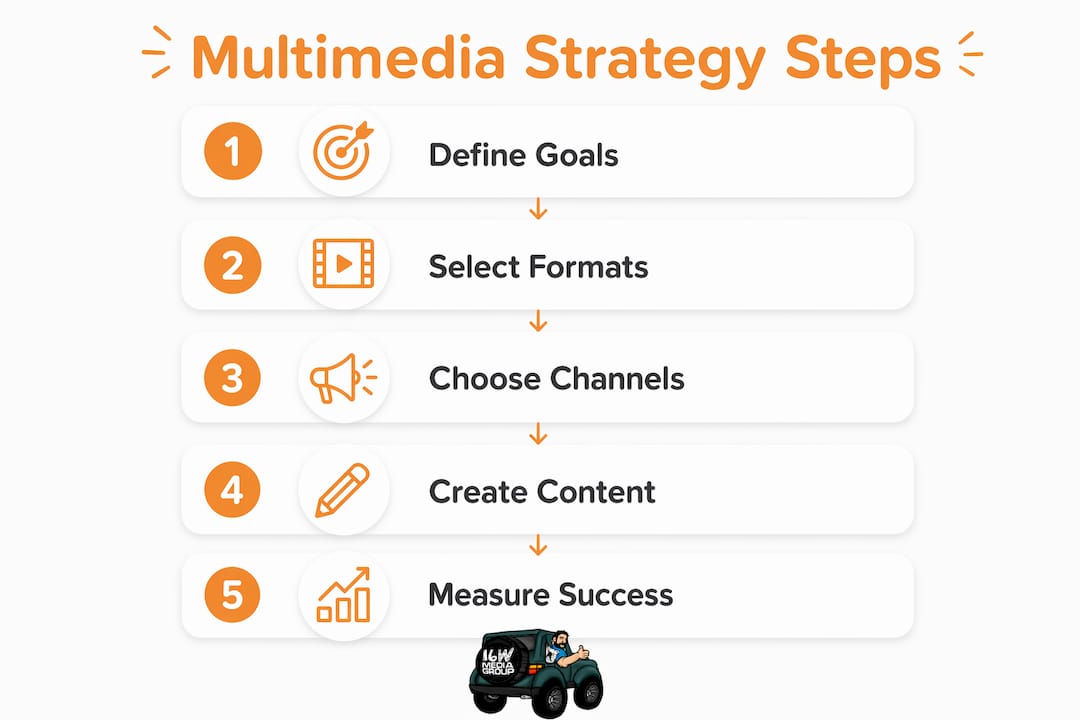
The multi-step process for implementing a multimedia strategy follows a clear sequence: set goals, define your audience, create pillar content, build a distribution calendar, and measure results. Skipping steps does not save time. It creates rework.
-
Set SMART goals. Define what success looks like before you produce anything. A SMART goal is Specific, Measurable, Achievable, Relevant, and Time-bound. “Increase podcast downloads by 30% in 90 days” is a SMART goal. “Get more awareness” is not.
-
Build audience personas. Identify where your audience spends time, what formats they prefer, and what problems they are trying to solve. A marketing manager at a mid-size company consumes content differently than a solo entrepreneur. Your personas should reflect those differences with channel preferences attached.
-
Create pillar content. A pillar piece is a long-form asset, such as a detailed guide, a webinar, or a podcast episode, that contains enough substance to be broken into multiple smaller pieces. One 45-minute podcast episode can become a blog post, five social clips, three email segments, and an infographic.
-
Build a content calendar. Map your pillar content and its derivative pieces across channels and dates. A calendar prevents gaps, reduces last-minute production pressure, and makes it easy to spot when you are over-indexing on one format.
-
Track performance and iterate. Review metrics every 30 days. Adjust formats, channels, or messaging based on what the data shows. A multimedia marketing plan is not static. It improves with each cycle.
Pro Tip: Trying to cover too many channels results in channel saturation, which dilutes your impact. Pick 2–3 formats that match your audience’s habits and master those before expanding.
Which multimedia formats and channels should you prioritize?
Format selection is where most multimedia strategies either gain traction or stall. The instinct is to chase the most popular platform. That instinct is usually wrong. An audience-first approach to selecting formats outperforms chasing popular platforms in both engagement and ROI. HubSpot’s media planning research confirms this directly.
The table below compares the most common multimedia formats across four practical dimensions to help you decide where to invest first.
| Format | Engagement Level | Production Cost | Resource Need | Best Use Case |
|---|---|---|---|---|
| Video (short-form) | Very High | Medium | Moderate | Brand awareness, social reach |
| Podcast / Audio | High | Low | Low | Thought leadership, loyal audiences |
| Blog / Long-form text | Medium | Low | Low | SEO, lead nurturing |
| Infographic | Medium | Medium | Moderate | Data storytelling, social sharing |
| Interactive content | Very High | High | High | Lead generation, product demos |
| High | Low | Low | Retention, conversion |
Video and audio consistently deliver the highest engagement per dollar for local businesses, which is why 16wmediagroup centers its service offerings around podcasts, community publishing, and traditional media integration. These are not trend-driven choices. They reflect where audience attention actually lives for high-value local consumers.
Channel selection follows the same logic. Social media platforms like Instagram and LinkedIn work for discovery. Email works for conversion. Podcasts work for trust-building over time. Community magazines work for reaching affluent, local audiences who are not reachable through digital-only campaigns. The best media channels for affluent audiences often include print and audio, not just social feeds.
How do you measure multimedia strategy success?
Measurement is where most multimedia marketing plans fall apart. Teams track vanity metrics like total views or follower counts and conclude the strategy is working when it may not be. Distinguishing between views and leads is critical because leads indicate higher quality engagement that drives conversion. Views tell you reach. Leads tell you impact.
Track these KPIs by format:
- Video: Watch rate (percentage who finish), click-through rate, and shares
- Podcast / Audio: Downloads per episode, listener retention rate, and referral traffic to your website
- Blog / Text: Time on page, organic search ranking, and email signups generated
- Email: Open rate, click rate, and revenue attributed per send
- Social content: Saves and shares (not just likes), profile visits, and link clicks
Review these numbers monthly, not quarterly. A 30-day review cycle gives you enough data to spot trends without waiting so long that a failing tactic drains your budget for weeks. Tools like Google Analytics 4, Spotify for Podcasters, and podcast advertising ROI platforms give you format-specific data that aggregate dashboards often miss.
AI and automation tools are changing how teams handle this analysis. Platforms that surface content performance patterns automatically reduce the time your team spends pulling reports and increase the time spent acting on findings. This is one area where technology genuinely changes the output-to-effort ratio for marketing teams operating without large analytics departments.
Key takeaways
A multimedia strategy works when it integrates the right formats, targets the right channels, and measures the right outcomes from the start of every campaign.
| Point | Details |
|---|---|
| Definition is foundational | A multimedia strategy combines formats, channels, and goals into one coordinated plan. |
| Start with 2–3 formats | Channel saturation dilutes results; master a few formats before expanding your mix. |
| Audience first, trends second | Select formats based on where your audience actually spends time, not what is currently popular. |
| Leads beat views | Track quality engagement metrics like leads and conversions, not just raw view counts. |
| Integrate early | Multimedia elements must be built into campaign planning from day one, not added later. |
Why most multimedia strategies fail before they start
I have worked with enough marketing managers to know the most common failure point: multimedia strategy gets treated as a production checklist rather than a planning discipline. Teams decide on a campaign concept, write the copy, design the visuals, and then ask, “Should we make a video for this?” That question should come first, not last.
Multimedia elements must be woven into campaign strategy from the start, not added as a visual afterthought. When you plan formats after the core message is locked, you end up forcing content into shapes it was not built for. A podcast episode written after a blog post feels like a blog post read aloud. A social graphic designed after an email campaign looks like a cropped screenshot. Neither performs well.
The other failure I see constantly is over-ambition at launch. A team decides to run YouTube, Instagram, LinkedIn, a podcast, a newsletter, and a blog simultaneously with a team of three people. Six weeks in, everything is behind schedule, quality drops, and the team burns out. The research is clear on this: prioritizing 2–3 formats aligned with audience habits produces better results than spreading thin across every available channel.
Start with what you can execute well. A single podcast series and a well-maintained email list will outperform a chaotic presence across six platforms every time. Scale only after you have proof that your core formats are working. That is not a conservative approach. It is the approach that actually produces compounding results over 12 months.
— Mike
How 16wmediagroup can build your multimedia strategy
Building a multimedia strategy that actually performs requires more than a content calendar. It requires the right channel mix, the right audience targeting, and a production partner who understands how formats work together.
16wmediagroup specializes in exactly that combination. From podcast production and community publishing to traditional media integration and regional ad campaigns, the team builds multimedia plans tailored to local business goals. Whether you are trying to reach affluent neighborhoods in Tampa or build brand loyalty through community-focused content, 16wmediagroup has the channel relationships and production experience to execute. Start with the local advertising campaign planning guide to see how a structured multimedia approach translates into real audience reach for businesses like yours.
FAQ
What is a multimedia strategy in simple terms?
A multimedia strategy is a plan that uses multiple content formats, such as video, audio, text, and images, across multiple channels to reach and engage a specific audience. It differs from a single-format campaign by coordinating all formats toward the same business goal.
How many formats should a multimedia marketing plan include?
Start with 2–3 formats that match your audience’s habits and production capacity. Research shows that channel saturation from covering too many channels at once dilutes impact rather than increasing it.
What makes a multimedia strategy effective?
Effectiveness comes from three factors: early integration of formats into campaign planning, audience-first channel selection, and consistent measurement of quality engagement metrics like leads rather than raw views.
How do i measure the success of my multimedia content strategy?
Track format-specific KPIs: watch rates for video, downloads and listener retention for podcasts, time on page for blog content, and open and click rates for email. Review these monthly and adjust based on what the data shows.
Can small businesses use a multimedia strategy without a large budget?
Yes. AI and automation tools like Copy.ai enable high-quality multimedia production without significantly increasing team size or budget. Starting with repurposed pillar content, such as turning one podcast episode into a blog post and social clips, keeps costs low while expanding reach.