

Your brand messaging is either working for you or quietly working against you. Most business owners assume the problem is budget, reach, or timing when campaigns underperform. The real culprit is often messaging that no longer reflects who the business is, who the customer is, or why the two belong together. Understanding why update brand messaging decisions matter, and when to act on them, is the difference between compounding brand equity and spending money that resets itself every cycle.
Table of Contents
- Key takeaways
- What brand messaging is and why consistency matters
- Refresh, rebrand, or messaging update
- Why local audiences require specific messaging
- Practical steps to update messaging effectively
- Measuring impact and balancing consistency with creativity
- My take on strategic messaging vs. unnecessary rebrands
- How 16wmediagroup helps you update and localize messaging
- FAQ
Key takeaways
| Point | Details |
|---|---|
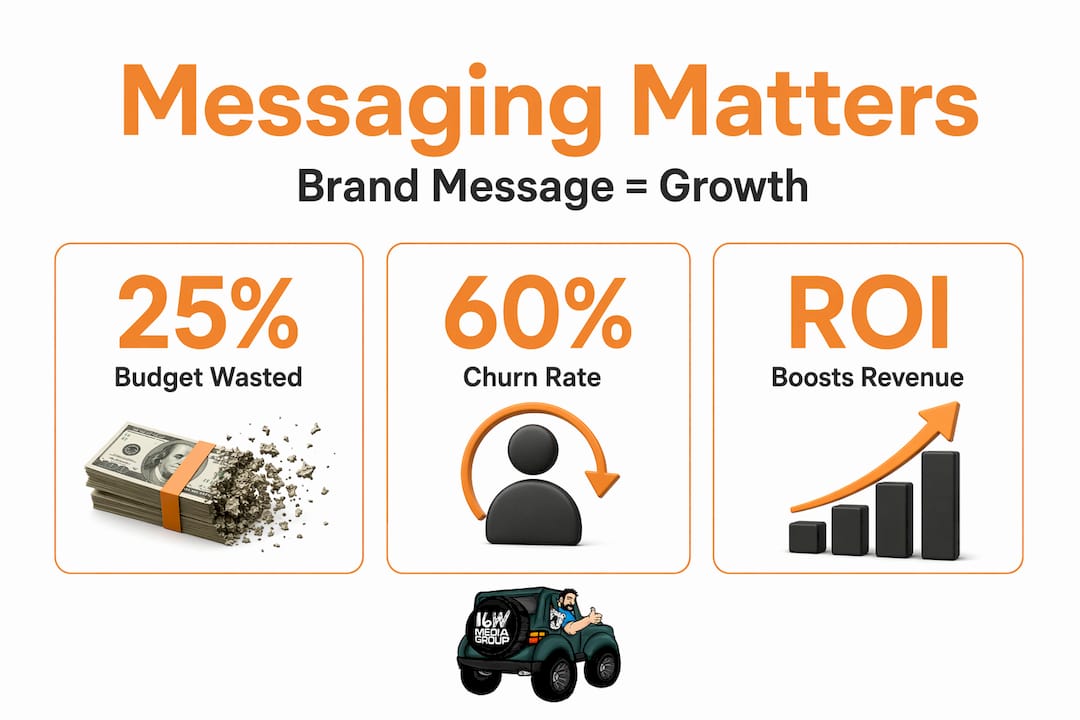
| Consistency drives ROI | Inconsistent messaging wastes up to 25% of marketing budgets and increases customer churn by 60%. |
| Refresh vs. rebrand matters | Confusing a messaging update with a full rebrand can destroy credibility and reset audience awareness you already paid to build. |
| Local specificity converts | Generic national messaging underperforms against community-specific storytelling that reduces the perceived distance between brand and buyer. |
| Cross-team alignment is non-negotiable | Sales teams excluded from messaging updates face stalled deals and confused conversations with buyers. |
| Narrative consistency compounds | Maintaining core positioning for three or more years yields two to four times better demand generation efficiency. |
What brand messaging is and why consistency matters
Brand messaging is not your tagline. It is the full system of language, tone, and narrative that tells customers who you are, what you do, and why they should care. It includes your value proposition, your voice across channels, the stories you tell, and the specific words your team uses to describe your offer.
Consistency across that system has a measurable financial return. Inconsistent messaging wastes up to 25% of marketing budgets and causes 60% more customer churn compared to brands with disciplined voice alignment. The math compounds quickly. When your social ads, website copy, sales scripts, and print materials all say slightly different things, you are forcing buyers to work harder to understand you. Buyers who have to work harder buy less.
The gap between having brand guidelines and enforcing them is where most businesses leak value. Research shows that only 25 to 30% of companies with written brand guidelines actually enforce them. That gap represents the single largest pool of uncaptured brand value in most organizations.
Here is what consistent messaging actually delivers:
- Trust acceleration. Consistency builds recognition, recognition builds trust, and trust shortens purchase decisions. Each touchpoint becomes proof of a reliable identity.
- Media efficiency. Brands with inconsistent messaging require 1.75 times more media spend to achieve the same growth as their consistent competitors.
- Email performance. Campaigns with consistent brand voice outperform generic ones with open rates and click-throughs, with some industries reporting over 300% improvement in customer lifetime value.
The importance of brand messaging is not abstract. It is a direct input to revenue.
Refresh, rebrand, or messaging update
These three terms get used interchangeably, and that confusion costs businesses real money.
| Term | What it means | When to use it |
|---|---|---|
| Messaging update | Adjusting language, tone, or positioning without changing visual identity | Audience shift, new product, or competitive pressure |
| Brand refresh | Updating visual identity and tone while preserving core equity | Brand feels dated but foundational positioning remains sound |
| Full rebrand | Overhauling name, identity, positioning, and sometimes audience | Merger, reputation crisis, or fundamental business pivot |
A messaging update is the most frequently needed and least dramatic of the three. You change how you talk about what you do without changing who you are. A refresh touches the look and feel. A full rebrand touches everything, and it carries the highest risk.

Jaguar’s 2024 global rebrand illustrates what happens when you confuse these approaches. The company launched a visual rebrand without a new product available for customers to actually buy. The result was disorientation and damaged trust. Creative boldness without a product or audience grounding does not fix messaging. It amplifies the gap.
Brands that update messaging too frequently create a different problem. Organizations that shift core positioning every 12 to 18 months lose awareness compounding and must rebuild buyer trust from scratch each time. You paid to move the needle. Changing course before that investment compounds is one of the most expensive mistakes in marketing.
Pro Tip: Before deciding between a refresh, rebrand, or messaging update, ask whether your product and audience have actually changed. If the answer is no, you likely need sharper enforcement of existing messaging, not a new direction.
Why local audiences require specific messaging
National campaigns are built to avoid offending anyone. That design flaw is precisely why they underperform at the local level. Local audiences respond better to tangible, community-specific messaging than to generic national campaigns, because localized storytelling reduces the perceived distance between brand and buyer.
Distance, in this context, is psychological. When a buyer in Tampa reads a brand message that could have been written for anyone in any city, they process it as corporate noise. When they read a message that names their neighborhood, references a local concern, or features someone they recognize, their brain classifies it differently. It becomes relevant, not promotional.
The highest-performing local brands use a modular campaign approach. The core message stays consistent. The local content slots change based on community, neighborhood, or audience segment. This means you are not writing new messaging from scratch for every market. You are swapping in authentic community storytelling within a proven message architecture.
Specific tactics that consistently improve local message relevance include:
- Place-based testimonials. A customer quote that mentions a specific street, school, or local business signals authenticity to local readers in a way that a generic five-star review never does.
- Community event references. Tying messaging to local events or seasonal patterns shows the brand is actually present, not just broadcasting.
- Local photography. Recognizable neighborhoods, storefronts, and faces outperform stock imagery for engagement in community-targeted media.
- Regional specifics in digital ads. Even simple geographic references in ad copy improve click-through rates for local businesses, particularly in hyperlocal digital placements.
Pro Tip: Build a simple content library of local photos, customer quotes, and community references you can pull from when customizing campaigns. Localization at scale requires organized assets, not just good intentions.
Exploring localized marketing strategies helps you see exactly how this approach works in practice for small and mid-size businesses competing against national brands.
Practical steps to update messaging effectively
The mechanics of a messaging update matter as much as the creative work. You can write the best positioning in your category and still fail to capture its value if the update process creates internal confusion.
-
Audit before you write. Document every customer-facing touchpoint: website, social profiles, sales decks, email signatures, printed materials, and verbal scripts your team uses on calls. You cannot update what you have not mapped.
-
Involve your sales team from day one. Sales teams excluded from the messaging update process face heavier, stalled deals due to misalignment. The people talking to buyers every day need to understand and believe the updated message before it goes public.
-
Run weekly cross-team syncs during the rollout. Coordinating weekly meetings during a messaging update can reduce churn by up to 15% by catching misalignment early and keeping messaging consistent across departments.
-
Write scripted FAQs for your team. Give sales, customer service, and marketing a shared document that answers the ten most common questions using the new messaging language. This prevents ad-lib responses that dilute the update.
-
Use pulse surveys post-launch. Short, frequent internal surveys in the first 60 days after a messaging launch surface confusion before it reaches customers. Ask your team: “How would you describe our core offer to a new contact today?”
-
Set a hold period. Commit to the new messaging for at least 90 days before evaluating performance. Most messaging updates need time to compound before showing measurable results.
Pro Tip: Create a one-page “messaging brief” that fits on a single screen. If your brand message cannot be summarized clearly enough for a new hire to understand in five minutes, it is too complicated for a buyer to process quickly.
When messaging isn’t grounded in real buyer pain, sales reps struggle to communicate urgency and value. The update process is also a chance to close that gap between what marketing writes and what buyers actually care about.
Measuring impact and balancing consistency with creativity
One of the most common mistakes after a messaging update is measuring it the wrong way. Sales figures are lagging indicators. By the time they reflect messaging confusion, you have already lost months of compounding.
Better metrics for tracking the impact of brand messaging include:
- Message recall accuracy. Ask recent leads or new customers to describe what your brand does in their own words. If the answers match your intended positioning, the messaging is landing.
- Inter-channel consistency audits. Quarterly reviews comparing language across your website, ads, email, and sales materials catch drift before it becomes expensive.
- Awareness compounding rate. Track brand search volume over time. Consistent positioning builds a recognizable identity that drives organic search behavior.
- Sales cycle length. When messaging aligns with real buyer pain, cycles shorten. Narrative consistency over three or more years yields two to four times better demand generation efficiency and faster sales cycles.
The creative pressure to change messaging because it “feels old” is one of the most common and costly traps in marketing. Familiarity is not failure. Buyers need to hear a consistent message multiple times before they act. Changing your core narrative because your team is bored with it resets that accumulation and forces buyers to start over.
The solution is giving your creative team latitude within the message architecture, not above it. Change the execution. Use different stories, formats, channels, and visuals. Keep the core positioning and language system intact. That balance is where the real benefits of messaging updates live: fresh execution on a proven foundation.
My take on strategic messaging vs. unnecessary rebrands
I have watched more businesses spend serious money on rebrands that were really just boredom in disguise. A new logo, a new color palette, a new tagline, and six months later the same conversations about why leads are not converting.
In my experience working with local businesses, the most impactful messaging work rarely looks dramatic. It looks like tightening a value proposition to reflect what buyers actually say in sales calls. It looks like replacing a generic headline with a neighborhood reference that makes someone stop scrolling. The impact of brand messaging done well is disproportionate to the effort when you are specific and disciplined.
The brands I have seen grow fastest in local markets did not rebrand. They figured out exactly what their community needed to hear and said it consistently, across every channel, for long enough that it compounded. The discipline to resist changing course before the investment pays off is genuinely rare. But it is the skill that separates brands that grow from brands that spin.
If you are feeling creative pressure to change your messaging, ask whether your current message has actually been deployed consistently enough to judge. Most of the time, the answer is no.
— Mike
How 16wmediagroup helps you update and localize messaging
If you have recognized that your messaging needs a focused update or a sharper local strategy, the next step is execution with the right support. 16wmediagroup works with local businesses in competitive markets like Tampa to develop messaging that connects authentically with community audiences and maintains consistency across every channel.
From community-focused publishing and podcast placements to multi-channel regional campaigns, 16wmediagroup builds the kind of media presence that turns updated messaging into measurable local engagement. Whether you are refining your positioning or launching targeted local campaigns, the team brings the strategic and creative resources to move fast and stay on message. Explore the full range of branding and media services to see where your messaging refresh fits into a broader growth strategy.
FAQ
Why update brand messaging instead of doing a full rebrand?
A messaging update adjusts how you communicate your offer without overhauling your visual identity or brand equity. Full rebrands carry the highest cost and risk, and are only warranted when the business itself has fundamentally changed.
When is the right time to change brand messaging?
The right time to update messaging is when your audience has shifted, your offer has expanded, or your current message no longer reflects real buyer pain. Avoid changing messaging simply because a campaign underperformed in the short term.
How does consistent messaging affect revenue?
Inconsistent brand messaging wastes up to 25% of marketing budgets and causes 60% more customer churn. Consistent messaging compounds awareness over time, shortens sales cycles, and reduces the media spend required to achieve the same growth.
What makes local brand messaging more effective than national campaigns?
Local audiences respond better to community-specific storytelling, local testimonials, and place-based references than to generic national campaigns because these elements reduce the psychological distance between the brand and the buyer.
How do you measure the success of a messaging update?
Track message recall accuracy, inter-channel consistency, brand search volume trends, and sales cycle length. These metrics reflect whether your messaging is landing before lagging sales figures confirm it.